

If you’ve been searching “Is CCNA worth it in 2026” — you’re in the right place. With artificial intelligence reshaping the entire IT landscape, many candidates are asking whether this classic Cisco certification still holds value — or has been made obsolete by automation and AI networking tools.
Many people are wondering, “Is CCNA worth it in 2026?” This question is crucial in today’s rapidly evolving tech landscape.
The short answer: Yes, “Is CCNA worth it in 2026?” is a question that more candidates are starting to ask.
CCNA remains one of the top 5 most in-demand IT certifications in 2026. AI is changing how networks are managed — but it cannot replace the human engineer who understands the fundamentals.
What Is the CCNA Certification?
Understanding whether “Is CCNA worth it in 2026” is essential for anyone considering a career in IT.
The Cisco Certified Network Associate (CCNA) — exam code 200-301 — is Cisco’s entry-level networking credential. It validates your ability to configure, manage, and troubleshoot modern networks. Since its major 2020 revamp, the CCNA now covers a broad range of topics including:
- Network fundamentals (IP addressing, routing, switching)
- Network security basics and access control
- IP services (DHCP, NAT, NTP, QoS)
- Automation and programmability (Python basics, REST APIs)
- Cloud networking fundamentals
- AI and machine learning in networking (added in v1.1, August 2024)
The CCNA 200-301 v1.1 update (August 2024) specifically added topics on generative AI, cloud network management, and machine learning — a direct acknowledgment that AI is now part of every network engineer’s toolkit.
Is CCNA worth it in 2026? The Honest Answer
To answer the question, “Is CCNA worth it in 2026?”, we must look at the current job market trends and salary data.
Yes — and here’s the data to back it up:
|
Metric |
2026 Data |
|
Average CCNA Salary (US) |
~$112,000/year |
|
LinkedIn Job Openings |
26,000+ active listings |
|
CCNA Job Demand Growth |
+16–18% vs 2023 |
|
AI-Based Enterprise Networks Growth |
32% in 2026 |
|
IT Leaders Struggling to Find Network Talent |
87% (Gartner) |
|
Certified Professionals Getting Pay Rise in 3 Months |
56% |
How AI Is Changing Networking — And Why That Helps CCNA Holders
Let’s address the elephant in the room: Yes, AI is automating repetitive networking tasks like configuration, troubleshooting, and log analysis. Tools like Cisco AI Network Analytics and SD-WAN powered by ML can now predict and resolve issues before humans even notice.
But here’s what AI cannot do — understand the WHY behind a network. AI tools require engineers who can:
- Design network architecture from the ground up
- Interpret AI-generated insights and make critical business decisions
- Troubleshoot novel problems AI has never encountered
- Ensure security, compliance, and disaster recovery
- Integrate AI networking tools with existing enterprise infrastructure
AI is a tool for network engineers — not a replacement. Just as calculators didn’t eliminate mathematicians, AI networking tools won’t eliminate Cisco-certified professionals. They just change the job scope.
What Jobs Can You Get with a CCNA in 2026?

The CCNA opens doors across multiple career paths — not just traditional networking roles. Here are the most common positions and their average US salaries:
- Network Administrator — $65,000–$85,000/year
- Network Engineer — $80,000–$110,000/year
- Systems Engineer (Entry Level) — $70,000–$95,000/year
- Technical Support Engineer — $55,000–$75,000/year
- IT Infrastructure Analyst — $75,000–$95,000/year
- Cloud Network Engineer (CCNA + Cloud) — $100,000–$130,000/year
- Cybersecurity Analyst (CCNA + Security+) — $90,000–$120,000/year
One powerful advantage of CCNA in 2026: It bridges networking with cybersecurity and cloud — two of the fastest-growing IT sectors. Employers increasingly want engineers who can do all three.
The relevance of the CCNA certification is evident when asking, “Is CCNA worth it in 2026?” It opens various career opportunities.
CCNA 200-301 v1.1: What’s New in 2026?
If you studied for CCNA before August 2024, the exam has been updated. The v1.1 update added critical new topics:
- Generative AI concepts and their role in network operations
- Cloud network management platforms (AWS, Azure networking)
- Infrastructure-as-code fundamentals
- ML-based network anomaly detection
- Zero-trust architecture basics
These updates make the CCNA directly relevant to AI-era networking roles. The certification is evolving alongside the industry — not falling behind it.
CCNA vs. Other Certifications in 2026: How Does It Compare?
|
Certification |
Difficulty |
Avg. Salary |
Best For |
|
CCNA 200-301 |
Medium |
$112K |
Networking foundation |
|
CompTIA Network+ |
Easy-Medium |
$80K |
Vendor-neutral basics |
|
CompTIA Security+ |
Medium |
$95K |
Cybersecurity entry |
|
AWS Solutions Architect |
Hard |
$130K |
Cloud architects |
|
CCNP Enterprise |
Hard |
$130K+ |
Senior network engineers |
|
Azure AZ-104 |
Medium |
$110K |
Azure infrastructure |
CCNA sits in the sweet spot — harder than Network+ (which employers value more), easier than CCNP (which requires real-world experience to fully absorb). For beginners and career switchers, CCNA delivers the best ROI in 2026.
Who Should Get CCNA in 2026?
CCNA is the right certification for you if:
- You want to start a career in IT networking, cybersecurity, or cloud infrastructure
- You’re a fresher or early-career professional (0–3 years experience)
- You’re moving from helpdesk/IT support into a networking role
- You want a globally recognized credential that stands out on your resume
- You plan to pursue CCNP, CCIE, or cloud certifications later
CCNA may NOT be your priority if you’re already an experienced senior network engineer with 7+ years of hands-on work. At that level, CCNP or cloud certifications will move the needle more.
How to Prepare for CCNA 200-301 in 2026
Passing CCNA on your first attempt in 2026 requires a structured approach:
Step 1 — Understand the Exam Format
The CCNA exam consists of 100–120 questions, including multiple choice, drag-and-drop, and simulation questions (lab configs on actual CLI). Duration: 120 minutes. Passing score: approximately 825/1000.
Step 2 — Use the Right Study Material
The best approach combines multiple resources:
- Official Cisco CCNA Study Guide (Wendell Odom)
- Practice exams and dumps with detailed explanations
- Packet Tracer or GNS3 for hands-on lab practice
- Video courses (CBT Nuggets, Udemy, Cisco NetAcad)
Step 3 — Practice, Practice, Practice
The biggest mistake candidates make is relying on theory alone. The simulation questions require you to configure real network devices in a CLI. Spend at least 40% of your study time in hands-on labs.
Step 4 — Use Practice Dumps Strategically
Practice exam dumps are an excellent tool to familiarize yourself with the question style and identify knowledge gaps. Focus on dumps that include full answer explanations — not just answer keys. This is where our exam prep material on this site becomes your biggest advantage.
When using practice dumps, don’t just memorize answers — understand WHY each answer is correct. CCNA simulation questions require real understanding, not just recall.
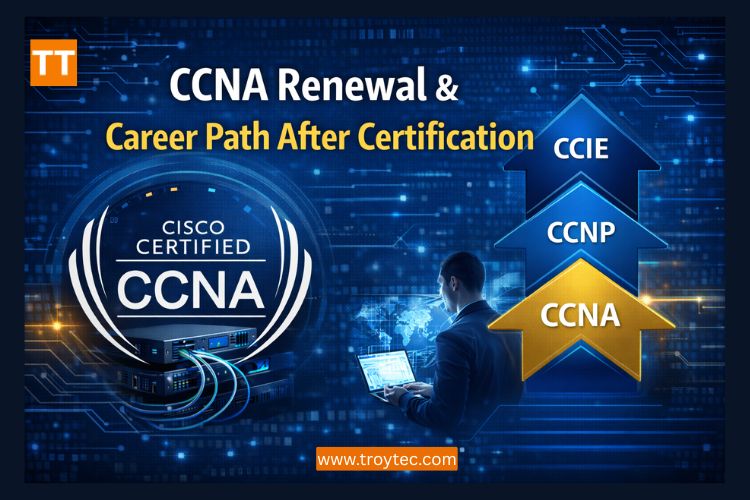
CCNA Renewal & Career Path After Certification
In summary, asking, “Is CCNA worth it in 2026?” is crucial for anyone looking to succeed in the IT field.
CCNA is valid for 3 years. To renew, you can pass the current CCNA exam again, pass a CCNP core exam, or earn continuing education credits through Cisco’s learning programs.
After CCNA, the most popular next steps in 2026 are:
- CCNP Enterprise — for senior network engineering roles
- CCNP Security — for cybersecurity specialization
- AWS/Azure Certifications — to pivot into cloud networking
- CCIE — for expert-level prestige and maximum salary
- CompTIA Security+ — to combine networking with security fundamentals
Frequently Asked Questions (FAQs)
Is CCNA enough to get a job in 2026?
Yes — CCNA is sufficient to land entry-level roles like Network Administrator, Technical Support Engineer, and Systems Engineer. However, pairing it with hands-on lab experience gives you a significant advantage in interviews.
How much does CCNA cost in 2026?
The CCNA 200-301 exam costs $330 USD (approximately Rs. 27,500 INR). Preparation materials, courses, and lab software are additional costs that can range from free (Cisco Packet Tracer, free courses) to $500+ for premium training programs.
Can AI replace network engineers with CCNA?
No — AI is transforming how networks are managed, but it cannot replace engineers who design, architect, and make critical decisions about infrastructure. CCNA v1.1 now includes AI networking topics, ensuring certified professionals can work alongside AI tools.
Is CCNA harder than CompTIA Network+?
Yes — CCNA is generally considered more rigorous than Network+. It has a stronger focus on Cisco-specific hardware and includes simulation lab questions. However, it also commands higher salaries and is more respected by employers.
How long does it take to prepare for CCNA?
Most candidates take 2–4 months studying 1–2 hours per day to prepare adequately. Those with prior networking experience may be ready in 4–6 weeks. Consistent lab practice is the most important factor.
Conclusion: Is CCNA Worth It in 2026?
The question remains, “Is CCNA worth it in 2026?” The evidence strongly supports a positive answer.
Absolutely — and here is the bottom line:
- CCNA demand is growing, not shrinking (16–18% job growth vs 2023)
- AI networking is creating new roles, not eliminating them
- The exam has been updated (v1.1) to include AI, cloud, and automation
- Average salary after CCNA: $112,000/year in the US
- It is a proven launchpad to CCNP, CCIE, cloud, and cybersecurity careers
If you are planning to build or advance a career in IT, you must ask yourself, “Is CCNA worth it in 2026?” It is one of the smartest investments you can make.
Browse our latest CCNA 200-301 practice dumps and study material — fully updated for the v1.1 exam. Start your preparation today and pass on your first attempt.
