

A reputable qualification for proving one’s proficiency in designing, developing, securing, and maintaining analytics systems utilizing AWS services was the BDS-C00 AWS Certified Specialty certification. Professionals pursuing more recent counterparts, such as the BDS-C00 AWS Certified Specialty certification, can still benefit from knowing the structure and emphasis of the BDS-C00 AWS Certified Specialty test, even if it has been decommissioned.
Big Data is a fairly broad topic in and of itself, and there is a lot to learn about AWS services to pass the test. It would be pretty beneficial to pass this BDS-C00 AWS Certified Specialty test if you have experience with Big Data technologies, including some visualization and machine learning.
Keep reading and exploring to learn how you can pass the Amazon-BDS-C00 AWS Certified Specialty in Big Data exam with our ultimate success guide and dumps.
What is Big Data?
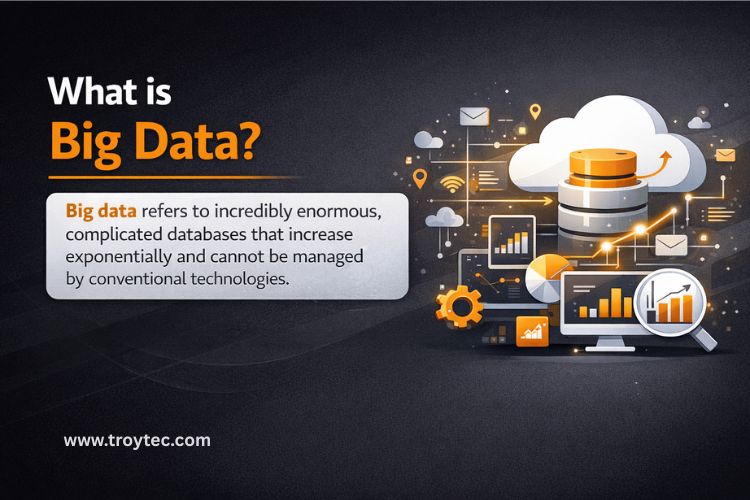
Big data refers to incredibly enormous, complicated databases that increase exponentially and cannot be managed by conventional technologies.
By using sophisticated technologies (like AI/ML) to analyze data from sources like social media, sensors, transactions, and user activity, businesses may identify trends, forecast behavior, make better decisions, and obtain a competitive advantage.
Data is currently produced at a never-before-seen rate due to
the proliferation of gadgets, sensors, internet services, and digital platforms. In order to properly collect, store, analyze, and use this data, firms must use cutting-edge tools and technology.
How Big Data Works?
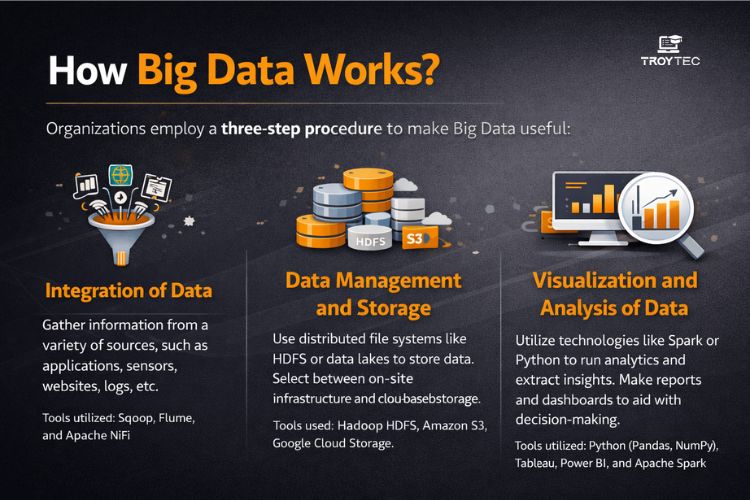
Organizations employ a three-step procedure to make Big Data useful:
-
Integration of Data
- Gather information from a variety of sources, such as applications, sensors, websites, logs, etc.
- Tools utilized: Sqoop, Flume, and Apache NiFi
-
Data Management and Storage
- Use distributed file systems like HDFS or data lakes to store data.
- Select between on-site infrastructure and cloud-based storage.
- Tools used: Hadoop HDFS, Amazon S3, Google Cloud Storage
-
Visualization and Analysis of Data
- Utilize technologies like Spark or Python to run analytics and extract insights.
- Make reports and dashboards to aid with decision-making
- Python (Pandas, NumPy), Tableau, Power BI, and Apache Spark were the tools utilized.
What is the BDS-C00 AWS Certified Specialty Big Data Certification?
The BDS-C00 AWS Certified Specialty test is designed for people who carry out intricate Big Data analysis. This BDS-C00 AWS Certified Specialty test verifies a candidate’s technical proficiency and background in creating and executing AWS services to extract Value from data.
It confirms the examinee’s capacity to:
- Use fundamental architectural best practices for implementing essential AWS Big Data services.
- Create and manage Big Data
- Make use of technologies to automate data analysis
The purpose of the BDS-C00 AWS Certified Specialty Exam is to assess a candidate’s proficiency with big data on the Amazon Web Services (AWS) system. Data warehousing, lakes of data, data streaming, data analysis, and data visualization are just a few of the many subjects covered in the AWS Certified Specialty BDS-C00 exam.
People should have practical experience with AWS services like Amazon Redshift, Kinesis, EMR, and Amazon QuickSight in order to be ready for the test. Big data technologies like Apache Hadoop, Apache Spark, and Apache Hive should also be known to them.
The AWS Certified Specialty BDS-C00 Exam verifies a person’s capacity to use AWS’s capability to handle and analyze massive volumes of data, which is one of its main advantages. Both individuals who wish to further their careers in the big data industry and companies seeking to get insights from their data may find this particularly helpful.
What are the BDS-C00 AWS Certified Specialty Exam Domains?
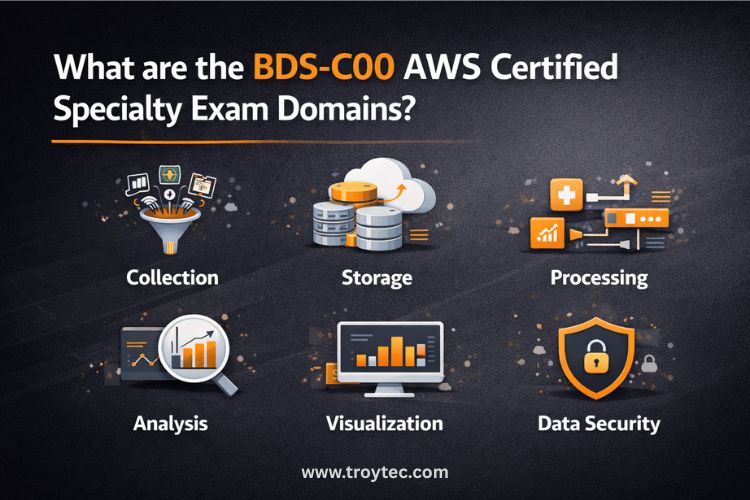
Only weightings, test domains, and goals are included in this exam guide. It is not an exhaustive list of all the information covered in this test.
Domain 1: Collection
- Identify the collecting system’s operating features
- Choose a data collecting system that can manage the type of data being ingested and the frequency of data changes.
- Determine which properties—such as order, data structure, metadata, etc.—the collection system must enforce.
- Describe the collection approach’s availability and durability features.
Domain 2: Storage
- Identify and enhance the storage solution’s operating features
- Identify patterns of data access and retrieval
- Assess methods for catalog entry capture, updating, and retrieval
- Choose the proper storage format and data structure
Domain 3: Processing
- Determine which data processing technique is best for a particular situation
- Decide on the data processing solution’s architecture and design.
- Ascertain the implemented solution’s operating features.
Domain 4: Analysis
- Identify the instruments and methods needed for Analysis
- Determine the analytical solution’s design and architecture
- Identify and enhance the Analysis’s operational features
Domain 5: Visualization
- Choose the best methods for producing outcomes or output
- Choose a design and development strategy for the visualization platform
- Identify and enhance the Visualization system’s operating features
Domain 6: Data Security
- Establish implementation technology and/or encryption requirements
- Select the right technology to implement data governance
- Determine methods to guarantee data integrity
- Estimate regulatory requirements
How to Pass the AWS Certified Specialty BDS-C00 Big Data Exam?
It takes more than a cursory understanding of AWS services to pass the AWS Certified Specialty BDS-C00 Exam. Professionals who work with large-scale data solutions and are knowledgeable in designing, implementing, and optimizing big data architectures on AWS are the target audience for this certification. The preparation process may be made much more efficient and manageable with an organized approach.
-
Gain A Thorough Understanding Of The Exam Blueprint
The first step is to comprehend precisely what is tested in the AWS Certified Specialty BDS-C00 Exam.
The test focuses on leveraging AWS services for data collection, storage, processing, Analysis, and visualization. Take some time to go over the official exam domains and make a note of each section’s weight.
Instead of studying everything equally, which frequently results in burnout and confusion, this lets you choose high-impact topics.
-
Establish A Robust Basis For Core AWS Data Services
Core AWS big data services, including Amazon S3, Amazon EMR, AWS Glue, Kinesis, and Amazon Athena, are essential for success.
Know when and why each service is utilized; don’t merely commit features to memory. For scenario-based test questions, it is essential to understand how these services work together.
-
Practice Real-World Data Architecture Situations
The BDS-C00 AWS Certified Specialty Real-world use cases are a significant component of the exam. Develop your ability to create complete data pipelines, from intake to analytics.
Examine situations involving data lakes versus data warehouses, batch versus streaming data, and cost optimization techniques.
-
Master Data Security, Governance, And Compliance
A critical aspect of the BDS-C00 AWS Certified Specialty test is security. Make sure you are familiar with data access control, IAM roles and rules, encryption at rest and in transit, and compliance best practices.
Many applicants undervalue this portion, yet it frequently contains challenging questions that, if disregarded, might affect your final score.
-
Practice With Troytec’s BDS C00 Dumps
Troytec’s BDS C00 dumps are a valuable tool for strengthening your preparation. These dumps offer:
- Exam-aligned practice questions that have been updated
- Exams using realistic circumstances and simulations
- Quick criticism of inaccurate responses
You may find knowledge gaps, enhance time management, and boost your self-confidence before the actual test by using these BDS-C00 AWS Certified Specialty dumps wisely. Don’t forget to utilize dumps as an additional tool, not as the only way to learn.
Sample BDS-C00 AWS Certified Specialty Exam Questions
Here are the sample BDS-C00 AWS Certified Specialty sample questions from our premium BDS C00 dumps. You can revise them before purchasing our premium BDS C00 dumps.
Question 1:
Which two license options are available for Oracle users using Amazon RDS?
- Enterprise License and BYOL
- BYOL and License Included
- License Included and Enterprise License
- Role-based and Included Licenses
Question 2:
To detect SPAM emails, a new Python algorithm has been developed. The system examines free text from a sample batch of one million emails that are kept on Amazon S3. The technique has to be stretched across a 5 PB production dataset that is stored on Amazon S3.
For this use scenario, which AWS service approach works best?
- To do text analysis on the in-memory data and export the model’s output to Amazon Machine Learning, copy the data into Amazon ElastiCache.
- Use a streaming program step in Amazon EMR to parallelize the text analysis activities throughout the cluster.
- Store the text using Amazon Elasticsearch Service, then analyze it against the text index using the Python Elasticsearch Client.
- Use AWS Data Pipeline to start a Python task that will run directly against the text files on Amazon S3.
Question 3:
In a Redshift cluster, an administrator must create a distribution plan for a star schema. The best distribution style for the tables in the Redshift schema must be chosen by the administrator.
Which three situations would make key-based distribution the best option? (Choose three.)
- When a big, slowly changing dimension table has to be optimized by the administrator.
- When lowering cross-node traffic is necessary for the administrator.
- When the administrator must balance the number of slices in the fact table.
- When the administrator must strike a balance between data collocation and dispersion.
- When the administrator needs to use a local node’s data locality for aggregates and joins.
Question 4:
A user intends to use RDS as a platform for managed databases. Which of the characteristics listed below does RDS not support?
- Automated backup
- Scaling automatically to handle an increased load
- Automated recovery and failure detection
- Patching software automatically
Question 5:
An Oracle RDS database has been set up by a user. When someone changes that database’s security group, the user wishes to be notified. How can that be configured by the user?
- Notifications of changes to the security group cannot be obtained.
- Set up SNS to track modifications to security groups
- Set up the DB security group’s event notification.
- Set up the CloudWatch alert for a security group change on the database.
Conclusion
Passing the BDS-C00 AWS Certified Specialty test is difficult, nevertheless. It assesses your proficiency with Kinesis, Glue, Redshift, data lake management, analytics workloads, and ML pipeline implementation. Troytec provides the best option in this situation. We provide data partitioning examples, query optimization tasks, streaming ingestion processes, and IAM rules for data governance in our BDS-C00 Exam Dumps. You can convert petabytes into validated insights using Troytec.
FAQs (Frequently Asked Questions)
What Is The AWS Certified Specialty BDS‑C00 Exam?
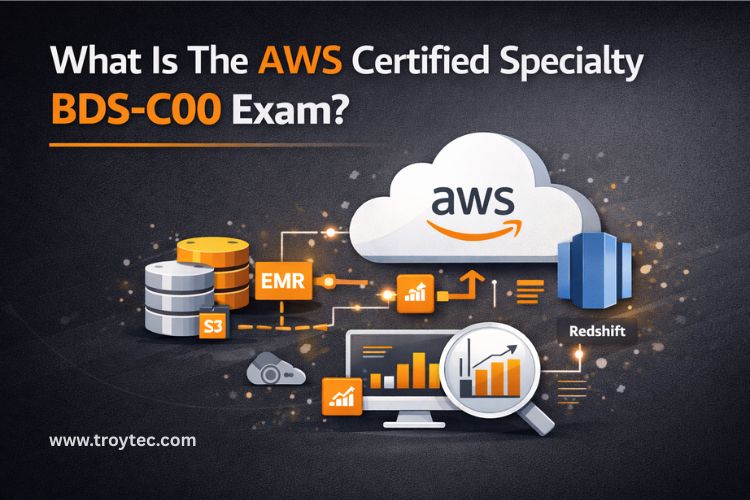
The AWS Certified Specialty BDS‑C00 exam is a specialty AWS certification that examines your ability to design, create, secure, and maintain Big Data and data analytics systems utilizing AWS cloud services, including EMR, Redshift, Kinesis, and Glue.
What Experience Do I Need Before Taking The BDS‑C00 Exam?
Before taking the AWS Certified Specialty BDS-C00 test, AWS advises having at least two years of practical experience with AWS data services and comprehension of data collection, storage, processing, Analysis, and visualization processes.
How Is The AWS Certified Specialty BDS‑C00 Exam Structured?
With different question counts and time constraints set by AWS, the test comprises multiple-choice and multiple-response questions covering important Big Data categories, including data input, storage, processing, and security.

Pingback: