
In a technological era characterized by widespread automation, distant infrastructures, and hyperconnectivity, networking certifications will still be highly relevant in 2026. The basic and advanced skills in networking design have transformed from desired to essential as businesses adopt cloud-first tactics, 5G rollouts, edge computing, and SD-WAN (Software-Defined Wide Area Networking).
The reality is more complex than the belief that networking certifications have lost significance as self-paced learning and open-source resources have become more accessible. Networking certifications continue to be tangible proof of a person’s dedication, organized knowledge, and technical acumen in a recruiting context stressing validated skills and result-driven recruiting.
Keep reading and exploring to learn how you can get networking specialist certification, certified network engineer certification, network infrastructure certification, and other best computer networking certifications in 2026.
Top Networking Certifications Preferred by Employers in 2026
Key Takeaways
- As companies depend on cloud networking, cybersecurity, 5G, SD-WAN, and hybrid infrastructures in 2026, networking certifications will still be quite relevant.
- Certifications such as Network+, CCNA, VCTA, CCIE, and CWNP enhance employability in competitive IT professions and confirm practical networking abilities.
- Increased earning potential, improved job stability, stronger career advancement, and greater reputation are all benefits for certified networking experts.
- Your career stage will determine which certification is best for you, from entry-level foundations to expert-level enterprise and wireless networking proficiency.
What is Computer Networking?
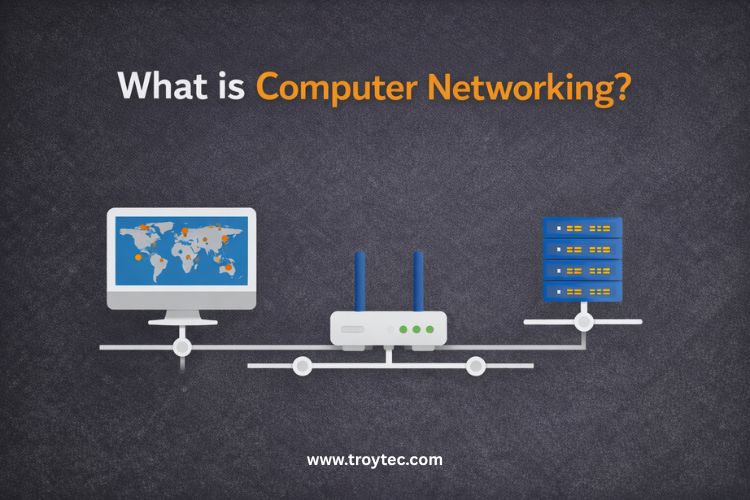
Computer networking is a method of connecting two or more computing devices (such as computers, phones, printers, and servers) throughout wired or wireless connections to communicate and share data, resources, and services using protocols (rules), which serve as the foundation for the internet, email, streaming, and cloud services.
In order to provide effective collaboration and information access, it entails the design, installation, and administration of the hardware (cables, routers) and software (protocols, apps).
How Does A Computer Network Work?

The fundamental components of computer networking are nodes and connections. A network node can be either data terminal equipment (DTE), like two or more computers and printers, or data communication equipment (DCE), such as a modem, hub, or switch. There are plenty of networking certifications in 2026.
The transmission media that join two nodes are referred to as a link. Links can be either open space utilized by wireless networks or physical, such as cables or optical fibers.
Nodes in a functional computer network adhere to a set of proper guidelines or protocols that specify how to transmit and receive electronic data over the links.
These logical and physical components are designed according to the computer network architecture. It offers the standards for the functional structure, protocols, processes, and physical components of the network.
What are Networking Certifications?
IT workers who demonstrate their proficiency in managing, maintaining, and troubleshooting computer networks are granted networking certifications. These certificates are essential for those who want to work in computer networking as they attest to one’s abilities in security, management, and network environments.
Computer networking certification is evidence of both technical proficiency and the ability to make a professional contribution in a demanding sector. For jobs like network engineers, systems administrators, and IT managers, many organizations only recruit certified specialists.
Why Getting Networking Certifications is Important in 2026?
With emerging changes in business sectors which have evoked a significant demand for the latest required skills in cybersecurity, cloud computing, and complex networking certifications, showcasing evidence of industry-recognized networking certifications should indeed be one of the top things on your to-do list.
Businesses want qualified experts who can create, oversee, and safeguard intricate networks. As a result, networking certifications attest to your knowledge and demonstrate that your abilities satisfy the demands of the modern workplace.
Because of this, trained personnel are more equipped to manage contemporary networking issues and swiftly adjust to new platforms and technologies.
-
Professional Development and Improved Employment Prospects
Networking certifications are a major factor in improving the career prospects for workers. Employers often favor certified candidates, as certifications minimize their expenses on training and their risks in recruitment. Consequently, networking certificates workers enjoy a lesser-known good reputation in highly competitive markets, greater job security, and faster upward mobility.
-
Developing Professional Credibility and Trust
Networking certifications show a dedication to career advancement. They demonstrate to clients and employers that you adhere to industry standards and best practices. As a result, certifications assist you in establishing credibility and establishing yourself as a trustworthy networking specialist.
-
Enhanced Income Potential and Employment Security
Networking specialists with certification typically make more money than their colleagues without certification. Additionally, in uncertain times, firms want certified personnel. As a result, networking certifications offer long-term financial stability and employment security.
5 Best Computer Networking Certifications You Must Get in 2026
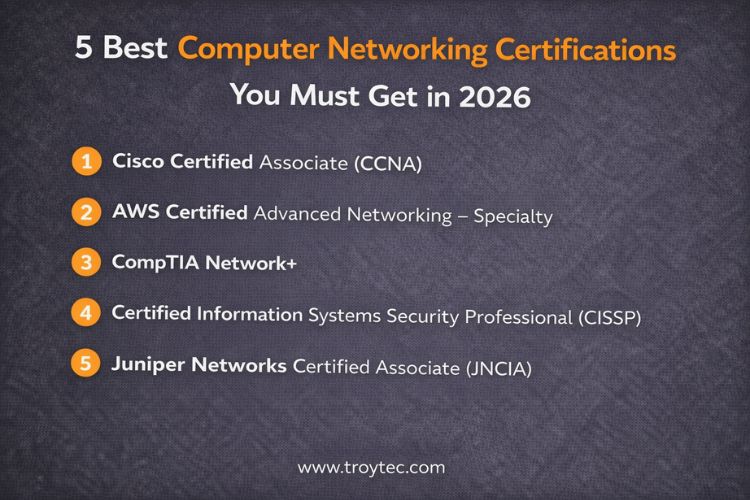
Here are the most valuable networking certifications you must get in 2026:
-
CompTIA Network+: The Fundamental Networking Foundation
For entry-level IT workers learning networking principles, earning the CompTIA Network+ certification is still a revered rite of passage. It offers a comprehensive understanding of fundamental networking ideas without being restricted by proprietary technology and is vendor-neutral. It is one of the best networking certifications.
There are about ninety questions on the certified network engineer certification (N10-008), which is composed of both performance-based and multiple-choice questions. The test, which includes five key domains, is given to candidates for ninety minutes.
- Concepts of Networking
- Infrastructure
- Network Functions
- Security of Networks
- Tools and Troubleshooting for Networks
On a scale of a total of 100 to 900, 720 is the passing score of these networking certifications.
The foundation for comprehending IP addressing schemes, subnetting, routing protocols (such as RIP, OSPF, and BGP at an introductory level), and physical vs virtual network interfaces is laid out in Network+.
Candidates become proficient in setting up simple SOHO routers, identifying connectivity problems, and putting basic security measures such as firewalls & access control lists (ACLs) into place.
The test also covers cloud-based networking ideas, cabling types (CAT5e, CAT6, fiber), and wireless protocols (802.11a/b/g/n/ac/ax). This foundation guarantees that students may easily navigate both conventional and contemporary networking environments.
-
CCNA, Or Cisco Certified Network Associate
One of the most well-known and esteemed networking certifications in the IT sector is the Cisco Certified Network Associate, or CCNA. Network access, IP connection, IP services, security principles, automation, and programmability are just a few of the many subjects covered by this certification, which offers essential networking knowledge.
The CCNA certification is ideal for corporate teams since it guarantees that your IT personnel are knowledgeable about networking fundamentals and equipped to manage intricate corporate networks.
It will improve your knowledge of IP connections, IP services, network access, programmability, and security principles. This certification will also allow you to have a basic understanding of this variety of topics:
- Automation
- Programmability
- WLAN
- NAT
- ACLs
- IP subnetting and addressing
- Utilities for networks
- Routers and switches
- Routing Protocols (OSPF)
- TCP/IP model
- LAN/WAN
Network engineers, network administrators, and network experts are among the many positions available to those with a CCNA networking certifications.
Depending on your experience and level of skill in the US, the typical annual income for a CCNA-certified professional ranges from $47,460 to $185,533.
-
VCTA
One of the top virtualization companies in the world, VMware offers a variety of networking certifications pertaining to the upkeep, configuration, and optimization of virtual machines, networks, and data centers. The kind of virtualization work you are acquainted with is covered by several VMware Certified Technical Associate certifications.
For entry-level networking professionals who wish to concentrate on virtualization or who know they will be applying to VMware-using firms, we suggest the VCTA-Network Virtualization or VCTA-Data Center Virtualization.
A VCTA may be earned without any prior networking expertise, although it can be more difficult than other entry-level certificates because it focuses on virtualizing existing technologies.
-
Cisco Certified Internetwork Expert, Or CCIE
One of the most prestigious networking certifications in the world, CCIE (Cisco Certified Internetwork Expert), is intended to distinguish among the best network engineers. Many firms regard CCIE as the most convincing computer networking certification available to network engineers. Because of their deep understanding of networking, those with CCIE certification are typically the leaders in the field.
To obtain this certification, you must have more than five years of networking experience. You will be able to design and manage complex enterprise networks with this qualification. To obtain CCIE certification, you should obtain entry-level Cisco certifications such as CCNA and CCNP.
In the US, however, the average annual pay for a CCNA-certified professional is $149,846.
-
CWNP: Using Wireless Proficiency To Master The Ether
The need for deep wireless knowledge has increased as wireless networks—which power workplaces, smart homes, medical devices, and industrial sensors—proliferate. To meet this need, the Certified Wireless Network Professional (CWNP) or networking certifications was created, providing a range of role-based certifications that attest to advanced wireless technical skills.
CWNP has several certification levels, ranging from basic wireless understanding to expert-level engineering:
- Certified Wireless Network Administrator (CWNA): Essential
- Security-focused CWSP (Certified Wireless Security Professional)
- Architectural Design: CWDP (Certified Wireless Design Professional)
- Protocol Analysis with CWAP (Certified Wireless Analysis Professional)
- Top-Tier Mastery with CWNE (Certified Wireless Network Expert)
The applicant gains a deeper comprehension of wireless theory, protocol behavior, RF propagation, security methods, and deployment strategy with each level.
CWNP is extremely helpful for Wireless Network Engineers, Infrastructure Architects, and Network Analysts who frequently deal with Wi-Fi troubleshooting, site surveys, or wireless security installation. Additionally, consultants working on high-density installations in arenas, colleges, and smart buildings find it to be an excellent option. It is one of the best network analyst certifications.
Which Certification Is Best for Networking?
Conclusion
The basic to advanced level networking certification is one of the most common networking certifications accessible in 2026, while there are many others that are available. Computer networking certifications are undoubtedly highly beneficial for today’s IT workers. Are you still unsure about the best course of action? To receive a network certification path consultation guide for your question, leave a comment below.
FAQs (Frequently Asked Questions)
Which Certification Is Best For Networking?
- CCNA, or Cisco Certified Network Associate
- CompTIA Security+
- Network+ CompTIA
- JNCIA-Junos, or Juniper Networks Certified Associate for Junos
- AWS Advanced Networking Certified Specialty.
What Is The Most Prestigious Networking Certification?
One of the most well-known IT qualifications is undoubtedly Cisco’s CCNA. Some networking specialists have used the CCNA alone to pursue full-time professions. It is the best network infrastructure certification.
Is CCNA Still Worth It in 2026?
In 2026 and beyond, CCNA is unquestionably worthwhile. Although the networking business is constantly changing, the core skills taught in CCNA are still very vital. Networking experts are more important than ever due to the growing complexity of digital networks.
What Are the Most Valuable Networking Certifications in 2026?
The most valuable networking certifications in 2026 include CCNA, CCNP, CompTIA Network+, AWS Advanced Networking Specialty, and Microsoft Azure Network Engineer Associate. These certifications are highly recognized by employers and validate skills in networking fundamentals, cloud infrastructure, security, and enterprise-level network management.
