
Somewhere between “I should probably learn cloud data engineering” and actually booking an exam date, most people end up with the same dozen browser tabs open: the official AWS exam guide, three or four practice-question sites, a Reddit thread from someone who “barely passed,” and a Medium post titled something like “what actually worked for me.”
I’ve been through that same stack of tabs. So instead of another generic overview, here’s what I wish had been in one place: what the DEA-C01 actually tests, how much of it is really about memorizing AWS trivia versus understanding trade-offs, a study plan that’s organized by exam weight instead of vibes, and an honest look at which “free” resources are actually free.
This guide breaks down everything you need to know about the AWS Data Engineer Certification (DEA-C01) — what it tests, what it costs, and how to actually prepare for it without wasting weeks on the wrong resources.”
|
❝
Quick answer: AWS DEA-C01 at a glance
Replaced: AWS Data Analytics – Specialty (retired) ❞
|
What Is the AWS Data Engineer Certification (DEA-C01), Really?
The AWS Certified Data Engineer – Associate (DEA-C01) is AWS’s associate-level certification for people who build, operate, and secure data pipelines on AWS. It launched in 2024, replacing the older AWS Data Analytics – Specialty exam, and it’s the first AWS certification built specifically around the actual day-to-day job of a data engineer rather than general cloud architecture.
More read : architect-vs-developer-saa-c03-vs-dva-c0
In plain terms, the exam wants to know: can you take raw data sitting in S3, Kinesis, or an RDS database, move it through something like Glue or EMR, land it in Redshift or a data lake, and keep the whole pipeline secure, monitored, and reasonably cheap the entire way through?
Officially, AWS says it validates your ability to:
- Ingest and transform data, and orchestrate pipelines using general programming concepts
- Choose the right data store, design data models, catalog schemas, and manage data lifecycles
- Operationalize, maintain, and monitor pipelines, and keep an eye on data quality
- Implement authentication, authorization, encryption, privacy, governance, and logging
Nothing there should surprise you if you’ve spent any real time building pipelines. The tricky part is that the exam tests judgment — knowing when Kinesis beats DMS, or when Redshift beats Athena on flat files — not just “what does this service do.”
The exam format, without the fluff
It’s 65 questions, 130 minutes, and it’ll cost you $150. Fifty of those questions are scored; the other 15 are unscored trial questions AWS is quietly testing for future exams, and you won’t know which is which, so treat every question like it counts. You need 720 out of a scaled 1,000 to pass, and there’s no penalty for guessing — so never leave a question blank.
There’s no hard prerequisite to register. AWS recommends candidates have 2–3 years of data engineering experience and 1–2 years hands-on with AWS specifically, but plenty of self-taught people pass it without that background if they put in focused, hands-on prep.
Here’s the basic exam info in one place, since you’ll probably want to reference it more than once while you’re planning:
| Industry or Function | Example Use |
|---|---|
| Marketing | Compare campaign traffic, leads, conversions, and cost per acquisition |
| Finance | Analyze revenue, expenses, risk, and transaction patterns |
| E-commerce | Study product demand, sales, customer behavior, and retention |
| Education | Compare enrolments, scores, ratings, and completion rates |
| Cybersecurity | Examine logs, incidents, and unusual activity |
| Healthcare | Explore operational, treatment, or patient data within privacy rules |
| Manufacturing | Track production, quality, downtime, and equipment performance |
What’s actually on it — the four domains
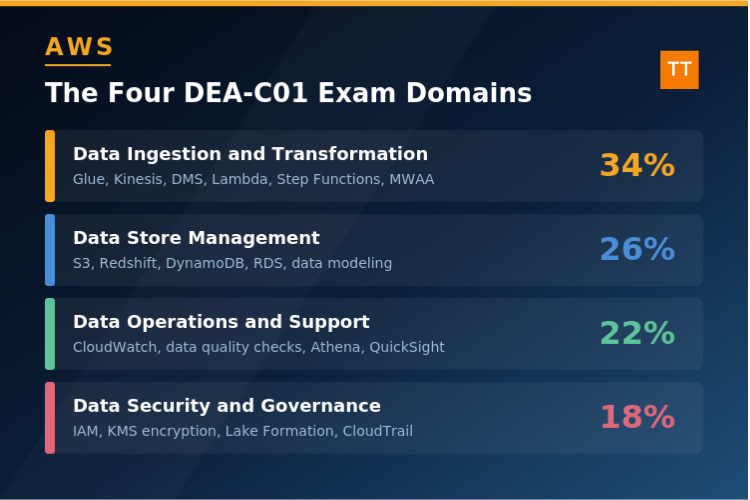
This is the part most overview articles skim past, and it’s honestly the most useful thing to organize your studying around. AWS splits scored content into four domains:
Data Ingestion and Transformation — 34%. This is the biggest chunk by far. Batch and streaming ingestion, ETL/ELT with AWS Glue, Kinesis Data Streams and Firehose, AWS DMS, Lambda, EventBridge, orchestration with Step Functions and MWAA (Managed Workflows for Apache Airflow), plus general concepts like idempotency, schema evolution, and reprocessing failed data.
Data Store Management — 26%. S3 storage classes and lifecycle policies, Redshift (including RA3 nodes and Redshift Spectrum), DynamoDB, RDS, ElastiCache, data modeling, partitioning strategy, and picking the right store for a given access pattern.
Data Operations and Support — 22%. CloudWatch monitoring, troubleshooting broken pipelines, data quality checks (AWS Glue Data Quality, Deequ), automating operational tasks, and analyzing data with Athena and QuickSight.
Data Security and Governance — 18%. IAM policies and roles, KMS encryption, Lake Formation for fine-grained data lake permissions, data masking, and audit logging with CloudTrail.
Ingestion/transformation and storage together make up 60% of the exam. If your time is limited, that’s where to spend most of it — but don’t skip security, because that 18% is exactly the domain people blow off and then quietly lose the points that would’ve gotten them over 720.
Is the AWS Data Engineer Certification worth doing?
Depends entirely on your stack, not your resume.
If the company you’re aiming for runs on AWS, this certification is currently the clearest resume signal you can send that says “I can build and run production data pipelines on this platform.” Recruiters filtering for data engineer, ETL developer, or analytics engineer roles will recognize it immediately.
If your target company runs on GCP or Azure, the underlying skills transfer just fine — data modeling, streaming vs. batch, pipeline orchestration are all portable concepts — but the certification itself won’t carry the same weight, and you’d probably get more mileage from the equivalent cert on that platform.
On compensation: data engineers with AWS certifications and a few years of experience commonly land somewhere in the $120K–$165K range in the US, though that swings a lot by region and seniority. Think of the cert as a door-opener and a resume filter, not a guaranteed raise on its own.
Most people report needing 40–80 hours of prep, roughly 6–8 weeks at an hour or two a day — less if you already work hands-on with AWS data services, more if you’re newer to the platform.
AWS Data Engineer Certification
Most “how to study” posts on this topic boil down to “take a course, do some practice tests, pass.” That’s not wrong, it’s just missing the sequencing that actually matters.
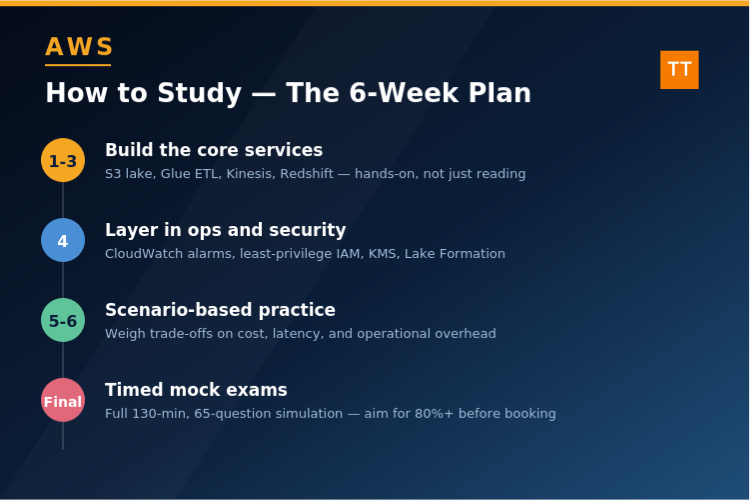
Weeks 1–3: build things, don’t just read about them.
Reading about Glue is not the same as debugging a Glue job that’s silently dropping half your rows. Spend this stretch actually building — an S3 data lake with partitioned Parquet data, a Glue crawler and ETL job on top of it, a Kinesis stream feeding Firehose into S3, and a Redshift cluster (or Serverless) loaded from that same S3 bucket, queried through Athena.
Week 4: layer in operations and security.
This is where a lot of self-taught candidates quietly fall behind, because it’s less satisfying than building pipelines. Set up CloudWatch alarms for pipeline failures, scope IAM roles down to least privilege for Glue and Lambda, and add KMS encryption and Lake Formation permissions to the data lake you built earlier.
Weeks 5–6: scenario-based practice questions.
The DEA-C01 is heavily scenario-driven — you get a paragraph describing a company’s setup, then several plausible-looking answers where two are technically correct and only one actually fits the stated constraint (usually cost, latency, or operational overhead). This is where a genuinely realistic AWS Certified Data Engineer Associate practice exam earns its keep — not by testing recall, but by making you weigh trade-offs the way the real exam does. For every question you miss, go find the actual AWS documentation explaining why the tempting wrong answer was wrong.
Final week: full timed mock exams.
Simulate the real 130-minute, 65-question format at least twice before you book your test date, and aim to consistently land above 80% before you schedule.
I ended up building a full DEA-C01 practice course around exactly this sequence — domain-weighted labs, then scenario questions, then timed mocks — mostly because I couldn’t find one resource that covered all three in the right order. If that’s useful once you hit this stage, check out our AWS Data Engineer Certification prep course it’s there; but the plan above works whichever materials you use to follow it.
Which study resources are actually free?
A good chunk of the searches around this exam are really just “what can I use before I spend any money?” I went through the resources that consistently show up at the top of search results for this exam and checked what’s genuinely free versus what just looks free on the landing page:
| Resource | Actually free? | AWS/DEA-C01 specific? | Best for |
|---|---|---|---|
| AWS Skill Builder (official) | Yes, fully free | Yes | Foundational concepts, official exam guide |
| Dataquest Data Engineer path | Partially — first few courses only | No | General Python/SQL fundamentals |
| Data Engineering Zoomcamp | Yes, fully free | No | Hands-on general pipeline building |
| TutorialsDojo practice exams | No, paid | Yes | Scenario-based exam practice |
| Udemy DEA-C01 practice courses | No, paid | Yes | Structured practice + explanations |
| TroyTec practice bundle ✅ Recommended | No, paid | Yes | PDF question bank + test engine + AI chatbot all available |
| Community exam-guide PDFs / dumps | Not safe to use | Yes (claimed) | Avoid — violates AWS policy |
Community-built curricula like the Data Engineering Zoomcamp are genuinely free and hands-on, but again — general data engineering, not AWS-certification-aligned.
Paid, exam-focused question banks are where most people who pass on their first attempt say the real jump in their score came from — realistic, scenario-style questions with detailed explanations that mirror the actual exam’s phrasing and difficulty, not just recall-based flashcards.
The thing almost every “top resources” roundup misses: you actually need all three pieces — free fundamentals, hands-on building in your own AWS free-tier account, and exam-specific scenario practice — and skipping any one of them is the most common reason people land just under 720 on their first attempt.If you’re just getting started, our guide to breaking into data engineering covers the fundamentals stage in more depth.
The mistakes that cause a first-attempt fail
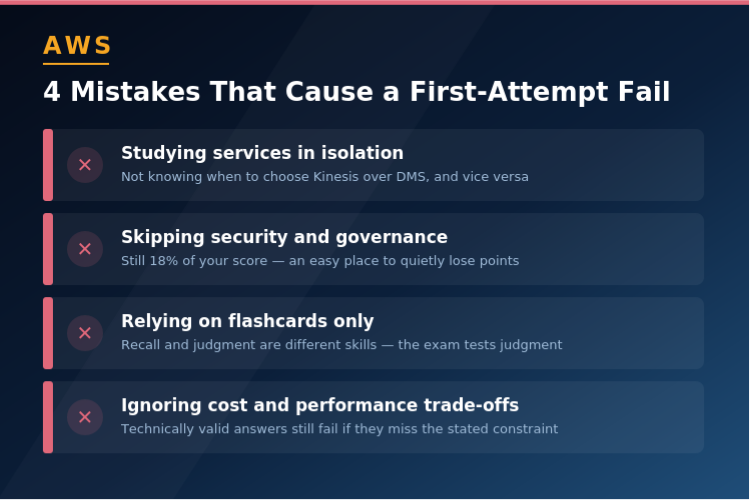
A few patterns show up over and over in people’s “what went wrong” posts:
- Studying services in isolation instead of end-to-end pipelines — the exam wants to know when you’d choose Kinesis over DMS, not just what each one does in the abstract.
- Skipping the security and governance domain because it’s less interesting than pipelines — it’s still 18% of your score, and it’s disproportionately easy to lose points there because people rush it.
- Relying on flashcards instead of full-length, scenario-based practice exams under real time pressure — recall and judgment are different skills, and this exam tests judgment.
- Ignoring cost and performance trade-offs — a huge share of the “obviously correct” wrong answers on this exam are technically valid solutions that fail on cost or operational overhead, which is precisely what AWS is testing for.
FAQs About DEA-C01
Q1
Is DEA-C01 hard?
Q2
Do I need 2–3 years of experience to take it?
Q3
Is Dataquest’s data engineering course free?
Q4
How long should I study?
Q5
What’s the difference between DEA-C01 and the old Data Analytics Specialty exam?
DEA-C01 replaced it and shifted the focus toward the practical, everyday work of building and operating pipelines, rather than deep specialty-level analytics and visualization.
