
When IT professionals consider virtualization career choices, the VCP-DCV certification is frequently used as a standard for certifying VMware data center expertise. This VMware certification exam focuses on real experience in establishing, operating, and improving virtualized infrastructure with vSphere. Unlike other IT certifications, it focuses on real-world system management and hands-on virtualization techniques.
Introduction
When it comes to the virtualization technology, VMware is without a doubt the market leader. IT specialists who can assist businesses in utilizing VMware products and services are thus in high demand. The purpose of VMware certification exam, such as the VMware VCP-DCV 2V0-17.25 Exam, is to develop and verify the knowledge and abilities required to utilize its technology.
One of the most well-known VMware certified professional certifications for verifying proficiency in virtualization and data center virtualization is the VMware VCP certification. It demonstrates your proficiency in VMware environment deployment, management, and optimization skills that are highly sought after in businesses.
Keep reading and exploring to learn what Data Center Virtualization (DCV) is, and how you can pass the VMware VCP-DCV 2V0-21.23 successfully.
What is Data Center Virtualization (DCV)?
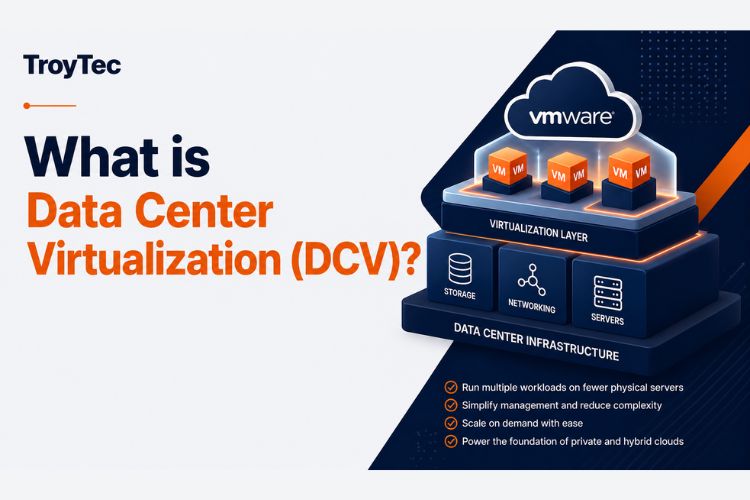
Data center virtualization is the process of converting physical data centers into digital data centers (i.e., virtual) via a cloud computing platform, allowing businesses to access information and applications remotely.
The technique abstracts physical hardware by simulating its processors, operating system, and other resources with the aid of a hypervisor.
Furthermore, a hypervisor is a piece of software that generates and controls a virtual machine (VM), hence facilitating interactions with a central processing unit (CPU). Typically, data center virtualization yields one or more cloud infrastructures, a linked system of virtualized hardware, and other digital elements.
What is the VMware VCP-DCV Certification?
The VMware Certified Professional – Data Center Virtualization (VCP-DCV) is a top-tier certification that validates knowledge in deploying, overseeing, and troubleshooting VMware vSphere architecture.
Earning the VCP-DCV VMware certification exam proves your knowledge of vSphere 8.x and can lead to employment opportunities in cloud computing, data center administration, and IT infrastructure management.
VMware credentials are highly regarded in the virtualization industry, therefore the VMware VCP certification is a good option for system administrators looking to further their careers in virtualization technology.
The VMware VCP certification is not only a show of technical skill, but it is also a prerequisite for those wishing to develop in fields such as data center processes, cloud computing, and IT systems management.
VCP-DCV VMware Certified Professional Certification Path — Prerequisites & Requirements
To get the VMware VCP certification, you must follow a systematic route. VMware certifications are more than just passing a test; they require formal instruction and practical experience.
- First, you must finish an official VMware training course. This is necessary to ensure that applicants grasp VMware technology at a deeper level. These courses are available in both instructor-led and self-paced formats, depending on your preferences.
- After finishing training, you must pass the VMware certification exam, which is usually the 2V0-17.25 or an updated version, depending on the year. This exam will assess your understanding of VMware vSphere architecture, implementation, networking, and troubleshooting.
Some candidates opt to take basic examinations such as 2V0-21.23, particularly if they are moving from prior certification tracks or updating their credentials.
2V0-17.25 Exam — Format, Topics & Passing Score
The VCP-DCV credential requires passing the VMware certification test 2V0-17.23. To pass confidently, you must comprehend the following exam’s structure, domains, and scoring criteria.
Exam Format
The VMware certification exam follows a systematic style that assesses both academic knowledge and practical abilities. Therefore, the VMware VCP certification has the following exam pattern:
- Multiple-choice and scenario-based questions.
- Real-world problem-solving scenarios.
- Approximately 135 minutes to finish.
- Available online or at authorized testing locations.
This approach guarantees that applicants can apply topics rather than simply memorizing them.
Also Read: Top 6 Strategies for VMware Exam Success
Exam Topics
The VCP-DCV test is largely focused on data center virtualization and real-world VMware settings.
- vSphere architecture and deployment
- Virtual Machine Creation & Management
- Network and storage configuration
- Security and access controls
- Performance improvement and troubleshooting
Compared to previous tests such as 2V0-21.23, the new exam focuses on hands-on abilities and practical application.
Passing Score
Understanding the grading system is critical to organizing your preparation.
- VMware uses a scalable scoring system.
- The passing score normally begins at 300.
- There is no negative grading for wrong responses.
To pass the VCP-DCV VMware Certified Professional, prioritize idea clarity and hands-on practice above guessing.
How to Study for VCP-DCV Exam?
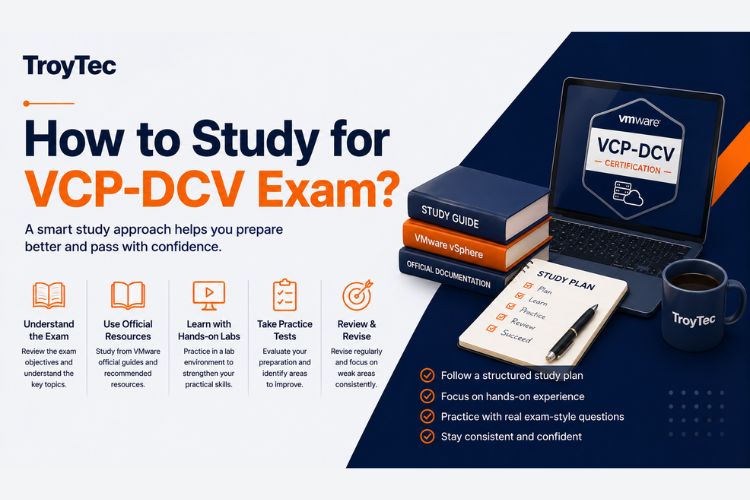
Preparing for the VMware certification exam is more than simply studying theory. The VCP-DCV is a practical certification; thus, your study plan should mix conceptual clarity with hands-on experience. The perfect combination of free and paid materials can considerably increase your chances of passing on the first try.
1. Begin with Official VMware Learning Resources
The most dependable place to start is with VMware’s official documentation and training materials. These materials are closely related to the test objectives and offer a thorough grasp of Data Center Virtualization topics.
While the content may appear complex at times, it guarantees that you are studying exactly what the test demands.
2. Create A Hands-On Lab Environment
Theory alone will not get you through the VMware VCP certification.
Setting up a home lab using VMware vSphere or similar technologies allows you to practice real-world situations including virtual machine (VM) deployment, networking setups, and troubleshooting.
This practical experience is frequently the difference between passing and failing.
3. Use Video Courses for Structured Learning
If you prefer directed learning, a structured VCP-DCV preparation course may help you understand complicated concepts.
Video-based courses divide complex subjects into small modules and frequently incorporate examples, making learning faster and more efficient.
4. Practice with Mock Exams and Test Simulations
Understanding the structure of the VMware certification exam requires practice examinations. They support time management, help you pinpoint your weaknesses, and boost your self-esteem.
To overcome changes in the actual test, concentrate on comprehending the reasoning behind each question rather than memorizing the answers.
Moreover, Troytec is your best exam preparation partner, and it offers you a real test engine and mock exams from which you can easily prepare for the VCP-DCV exam to get the highest score.
5. Strategically Integrate Paid and Free Resources
Building basic knowledge may be facilitated by using free resources such as documentation, forums, and community conversations.
On the other hand, paid resources frequently include exam-focused insights, updated information, and organized study pathways. Combining the two guarantees thorough preparation without overlooking important subjects.
6. Maintain a Regular Study Schedule
When getting ready for the VCP-DCV, consistency is more important than intensity. Cramming might be less productive than studying for one to two hours per day with a defined schedule. Concentrate on one subject at a time, practice it in your lab, and then move on to the next.
Also Read: Advanced Design Roadmap to Passing the VMware vSphere 7. x Exam – A Complete Guide
VCP-DCV vs Other VMware Certs — Which Should You Choose?
Here is a quick comparison table from which you can have a clear idea about which you should choose between VCP-DCV and other VMware certifications in 2026:
| Factor | VCP-DCV | Other VMware Certs (VCTA, VCAP, VCDX, VCP Tracks) |
|---|---|---|
| Level | Mid-level (Professional) | Ranges from beginner (VCTA) to expert (VCDX) |
| Focus | Core data center virtualization (vSphere) | Specialized areas like cloud, networking, and security |
| Difficulty | Moderate, hands-on technical | Varies from basic (VCTA) to highly advanced (VCDX) |
| Career Stage | Best for system administrators and engineers. | Entry-level to architect-level positions. |
| Scope | Deep focus on vSphere infrastructure | Broader or niche skills (NSX, cloud, automation) |
| Use Case | Foundation for VMware careers | Specialization or career advancement |
| Career Value | Industry-standard baseline cert | Advanced certs offer higher specialization & salary. |
Which one You Should Choose?
- Choose VCP-DCV if you want a solid foundation in VMware virtualization, particularly for positions such as system administrator or virtualization engineer.
- Select other VMware certifications based on your level:
- Choose the VCTA certification if you are a beginner
- Choose the VCAP certification if you want advanced technical expertise
- Choose the VCDX certification if you have architect-level role goals
- Go for other VCP certification tracks if you prefer cloud, networking, or security specialization
Career Advantages of VCP-DCV Certification
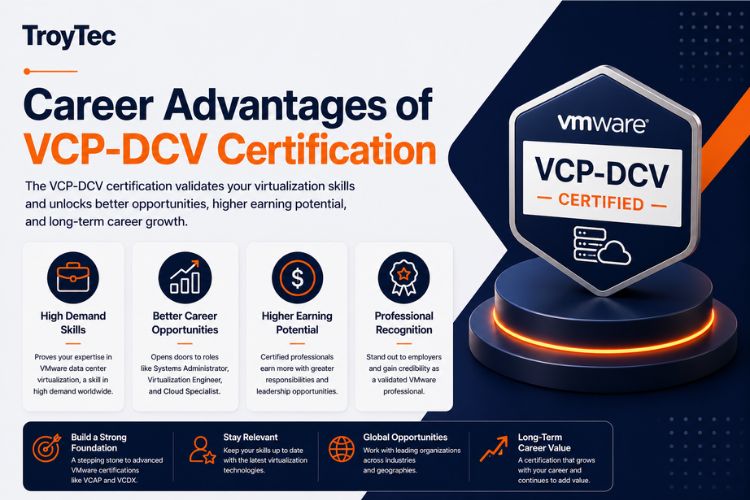
Earning the VCP-DCV certification can lead to a variety of job prospects. Companies across sectors use virtualization to manage their IT infrastructure, and qualified personnel are in great demand.
The certification confirms your technical knowledge and proves your ability to deal with real-world situations. It may lead to positions such as system administrator, virtualization engineer, or cloud expert.
In addition to career advancement, credentialed professionals frequently receive better wages than their non-certified counterparts. This makes the VMware VCP certification a worthwhile investment for your future.
Is the VCP-DCV VMware Certification Exam Difficult?
Earning your VCP-DCV certification may be academically challenging and time-consuming, especially if you’re juggling it with full-time work or school obligations. However, the key is to maintain a systematic and consistent approach.
Create a study timetable that divides the material into small chunks and allows time for practical labs. The VMware Hands-on Labs which provide you with access to fully configured scenarios enable you to practice without needing to build complex systems. The immersive exercises which we provide help students learn by using their knowledge in real situations.
It’s also beneficial to connect with a study group or a learning partner. Collaborating with peers may open up fresh views, increase motivation, and develop a feeling of accountability.
Conclusion
More than merely a test, the VCP-DCV VMware certification exam certification opens doors to a secure and fulfilling career in IT infrastructure. You may pass the VMware certification test with confidence if you follow the correct path, have practical experience, and use trustworthy materials.
Concentrate on developing practical abilities rather than hurrying through the process. This helps you pass the test and get you ready for problems in the real world.
It is completely possible to obtain your VCP-DCV certification if you maintain consistency and adhere to a methodical approach.
FAQs (Frequently Asked Questions)
How Much Does The VMware Exam Cost?
The price range for a VMware certification is $250 to $1990.
Where Can I Take the VMware Certification Exam?
Before you can take VMware’s examinations to become a VCP-DCV (VMware Certified Professional), you must finish the official VMware IT Academy courses. The proctored exam may be taken at a participating Pearson Vue testing facility, while the unproctored exam can be taken online.
Why Are People Leaving VMware?
You are already aware of the substantial disruption caused by Broadcom’s acquisition of VMware if you have been keeping up with the changing virtualization environment. That is the main reason people are leaving VMware.
