
|
❝
CompTIA Security+ certification (SY0-701) is the world’s most well-known entry-level cybersecurity certification. It certifies fundamental abilities in threat detection, risk management, network security, and incident response. The exam costs $404–$425, comprises up to 90 questions in 90 minutes, and requires a passing score of 750/900 ❞
|
- CompTIA Security+ (SY0-701) is the most well-recognized entry-level cybersecurity certification in the world.
- The exam comprises up to 90 questions in 90 minutes, with a passing score of 750 out of 900, and will cost between $404 and $425 USD in 2026.
- Prior certification is not necessary, CompTIA recommends Network+ and at least two years of hands-on IT experience.
- Certified professionals make between $65,000 and $115,000 or more per year, depending on their function and level of expertise.
- The certification is valid for three years and requires renewal through CompTIA’s Continuing Education (CE) program.
- You can take the exam in person at a Pearson VUE test center or online via remote proctoring. Both choices are equally acceptable.
- Security+ provides access to advanced certifications such as CySA+, PenTest+, CASP+, and CISSP.
Introduction
The appropriate preparation route leads to exam success. So, to secure your success on the CompTIA Security+ certification test, we’ve put together a thorough guide to help you prepare for the certification. Let’s get started so we can succeed on the exam.
Security is undeniably a key priority for the majority of businesses handling IT operations. In today’s marketplaces, it is nearly impossible for a business to avoid using digital platforms.
As a result, businesses must accept the risks and difficulties that come with digital transformation. Ultimately, there is an ongoing demand for qualified and experienced cybersecurity specialists.
Indeed, the emergence of new technology is opening up new job prospects for cybersecurity specialists in a variety of professions.
As a result, many IT workers aspiring to employment in cybersecurity seek reliable credentials that can demonstrate their abilities and expertise. As a result, there is an increasing demand for instruction on the CompTIA Security+ Study Plan.
Keep reading and exploring to learn more about jobs with CompTIA Security+ and study for the CompTIA Security+ guide.
What is CompTIA Security+ Certification?
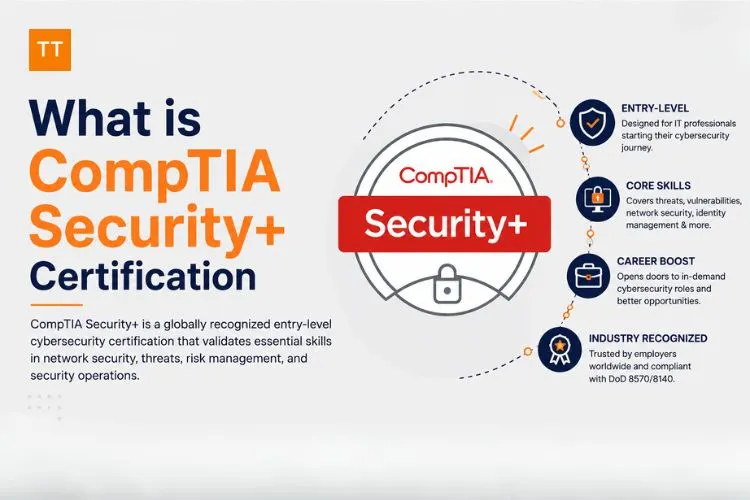
CompTIA Security+ certification is a popular entry-level cybersecurity certification that verifies the fundamental skills required to carry out key security activities in an organization.
With over 6,500 current CompTIA Security+ certification jobs needing the certificate at any given moment, it is the starting point for cybersecurity professions in government, defense, healthcare, finance, and corporate IT.
The latest edition (SY0-701) was released in November 2023 and presents essential cybersecurity content which addresses current threat patterns through its coverage of zero trust system development and cloud security and AI-based threat assessment and supply chain security protocols.
Most importantly, the Security+ credential includes new risk management methodologies, threat management, intrusion detection, risk mitigation processes, and best practices.
Who Is This Certification For?
Individuals who wish to build or enhance their cybersecurity skills should take the CompTIA Security+ exam.
This certification is particularly appropriate for:
- Aspiring cyber professionals
- IT support experts seeking development
- Network administrators
- System administrators
- Security analysts
- Help desk staff are migrating into security jobs
- Military and government workers are working for DoD-approved credentials.
- Career changers are entering the cybersecurity profession.
Although there are no essential requirements, CompTIA advises that you have basic networking and IT expertise before taking the CompTIA Security+ exam.
Not sure if Security+ is your next step?If you have little to no IT experience, consider starting with CompTIA A+ or CompTIA Network+ first. Developing that foundation will make Security+ preparation much easier and more successful.
Why Should I Get CompTIA Security+ Certified?
If you’re wondering if this CompTIA Security+ certification is worth your time and money, businesses and industry experts agree: it is completely worthwhile.
CompTIA Security+ is widely regarded as the industry standard for starting a career in cybersecurity. It is the most often used credential among early-career security professionals. Here’s why it’s important to both new and veteran IT professionals:
It Proves Your Knowledge
Earning a certification validates to employers that you have the necessary abilities for the job. Security+ demonstrates your ability to perform real-world security responsibilities such as threat detection, risk management, and incident response. Hiring managers know exactly what a Security+ holder brings to the table.
It Helps You Grow Quicker In Your Career
According to studies, IT workers who possess credentials are more likely to get promoted and start at better incomes than those who do not. In fact, nine out of 10 companies believe credentials are vital when searching for the ideal individual. Obtaining certification provides you with an advantage before you ever sit down for a job interview.
It Sets Up Your Next Certification
CompTIA Security+ isn’t your end destination. It is the foundation for everything that follows. Once you obtain it, you will be well-positioned to seek more specialist certifications in areas such as penetration testing, cloud security, and threat intelligence.
It Creates An Impact
According to new data, IT workers who hold CompTIA A+ or CompTIA Security+ certifications outperform those who do not.
It Keeps Your Career Relevant
Cybersecurity is one of the most rapidly increasing industries in the technology industry. There are more vacant security positions than competent candidates to fill them. Obtaining Security+ today indicates that you are prepared to take on such challenges for years to come.
Is Security+ Worth It in 2026?
Yes, and the job market makes the strongest argument for it.
There are already hundreds of thousands of vacant cybersecurity positions worldwide. Companies in government, healthcare, banking, defense, and corporate IT are all trying to recruit trained security personnel. CompTIA Security+ is the most often approved entry-level accreditation that hiring managers seek when filling these positions.
In 2026, Security+ is an important pursuit since it:
- Validates real-world cybersecurity capabilities.
- Helps applicants qualify for security-related jobs.
- Encourages conformity in government and regulated enterprises.
- Creates a road for advanced cybersecurity certificates.
- Provides solid fundamental knowledge for long-term job advancement.
The financial reward is also something to consider. The examination costs between $404 and $425. Entry-level positions for Security+ holders generally pay $65,000 to $80,000 per year, with opportunities to advance as you acquire experience. The credential essentially pays for itself during the first week of employment.
Can You Get a Cybersecurity Job With Only CompTIA Security+ in 2026
CompTIA Security + Exam Format
To pass this test, you’ll need to prepare well. The test allows you 90 minutes to complete 90 questions and requires a minimum score of 750 out of 900 points. Obtaining your Security+ certification in 60 days may appear difficult, but it is entirely feasible if you use the proper study strategy.
Here’s the exam format at a glance:
| Factor | Information |
|---|---|
| Exam Code | SY0-701 |
| Number of Questions | Maximum 90 |
| Time Limit | 90 minutes (1 hour 30 minutes) |
| Passing Score | 750 out of 900 |
| Exam Cost | $404–$425 USD (2026) |
| Certification Validity | 3 years |
| Recommended Experience | CompTIA Network+ and 2 years of IT security experience |
| DoD Compliance | Satisfies DoD 8570/8140 IAT Level II |
Online vs In-Person Testing: Which is Best?
When you’re ready to take the exam, you have two options: take it in person at a Pearson VUE test center or online with a remote proctor.
Moreover, CompTIA readily treats both options equally and provide the exact same Security+ certification to you. No matter you choose online exam or in-person, your overall score and certification will remain the same.
Here’s a side-by-side comparison to help you determine which choice is best for you.
Prerequisites for CompTIA Security+ Certification
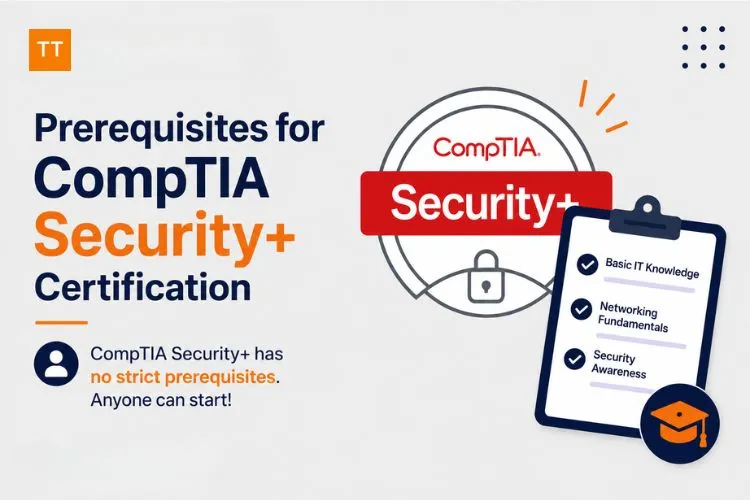
CompTIA recommends that applicants get the CompTIA Network+ certification before pursuing the CompTIA Security+ exam.
In addition, candidates should have at least two years of hands-on IT administration experience, with a focus on security.
Furthermore, applicants for the CompTIA Security+ certification should have prior technical knowledge in information security.
Most importantly, applicants preparing for the Security+ exam should have a broad range of skills and understanding of security problems and security infrastructure deployment.
What are the Domains Covered in the CompTIA Security+ (SY0-701) Exam?
Your Security+ journey covers five critical domains that are directly applicable to daily security operations:
- General Security Concepts (12%):Core security concepts such as confidentiality, integrity, and availability that serve as the foundation for all security measures.
- Threats, Vulnerabilities, and Mitigations (22%): Assessing attack vectors, discovering vulnerabilities, and devising effective countermeasures.
- Security Architecture (18%):Designing secure systems and networks to safeguard your organization’s assets.
- Security Operations (28%): Monitoring environments, identifying abnormalities, and efficiently responding to events.
- Security Program Management and Oversight (20%): aligning security practices with business goals through adequate governance and risk management.
CompTIA Security+ credential is an excellent starting point for a career in cybersecurity, including positions such as Security Analyst, IT Auditor, and Security Administrator. Your Security+ accreditation proves your organization’s dedication to protecting important assets via proven security knowledge.
For prep: SY0-701 CompTIA Security+ Certification Exam – CompTIA Certified
How to Study for CompTIA Security+ Certification?
The most crucial strategy for preparing for the CompTIA Security+ Certification is to combine organized learning with frequent practice tests. Here’s a tried-and-true method that gets 70-80% of well-prepared applicants through on their first try.
Prerequisites Before You Start
As we discussed earlier, Prior certifications are not required to take Security+; your study will be substantially simpler if you have
- Basic knowledge of networking (TCP/IP, DNS, firewalls, VPNs).
- Experience with Windows and Linux operating systems.
- Some experience in IT support or systems administration (recommended: two years).
If you have no prior IT experience, begin by studying the CompTIA Network+ exam basics for 4-6 weeks.
Best Study Resources for SY0-701
Free resources:
- Professor Messer’s free SY0-701 video course (professormesser.com) is regarded as the gold standard free resource.
- CompTIA’s official test objectives document—download and use it as your syllabus
- Jason Dion’s YouTube channel for concept reinforcement.
Paid resources:
- Troytec SY0-701 practice test dumps, updated for current objectives, cover all four domains.
- CompTIA CertMaster Practice provides official practice questions with adaptive learning.
- Jason Dion’s Udemy courses are highly rated and inexpensive.
Practice Exam Strategies
- Start practicing in week two, not week six.
- Aim for 80%+ on full-length practice examinations before scheduling the actual test.
- Focus on comprehending why each response is accurate, rather than memorizing answers.
Also Read: IT Certification Jobs: Ultimate Guide to High-Paying Careers
CompTIA Security+ Study Plan in 8 Weeks
If you have basic networking knowledge, follow this organized CompTIA Security+ Study Plan schedule. Adjust the timeframe according to your expertise level. Full novices should add 2-4 weeks. Here is a full CompTIA Security+ certification study plan:
Week 1-2: General Security Concepts (Domain 1)
Topics to Cover:
- Security controls include technological, administrative, physical, preventative, detective, and remedial measures.
- CIA triad, non-repudiation, AAA (authentication, authorization, and accounting).
- Fundamentals of zero trust architecture.
- Cryptography fundamentals: symmetric vs. asymmetric, hashing, and PKI.
Study goal: First and foremost, understand the fundamental terminology and models.
Daily time: 1.5 to 2 hours
Practice: 20 domain-specific practice questions every day at the end of week two.
Week 3–4: Threats, Vulnerabilities, and Mitigations (Domain 2)
Topics to Cover:
- Malware kinds include ransomware, trojans, worms, rootkits, and spyware.
- Social engineering techniques include phishing, vishing, smishing, pretexting, and baiting.
- Application threats include SQL injection, XSS, buffer overflows, and race conditions.
- Network assaults include DDoS, man-in-the-middle, DNS poisoning, and ARP spoofing.
- AI-powered threat identification and behavioral analytics (New in SY0-701)
- Supply Chain Attacks and Third-Party Risk
- Mitigation approaches include segmentation, patching, hardening, and access restriction.
Study goal: Be able to recognize attack types from scenario descriptions and choose the appropriate mitigation.
Daily time: 2 hours.
Practice: Run a complete 90-question practice test at the end of week 4. Review each incorrect answer.
Week 5-6: Security Architecture (Domain 3—18%)
Topics to Cover:
- Network segmentation, VLANs, DMZs, and screened subnets.
- Cloud security approaches (IaaS, PaaS, SaaS) and shared accountability
- Hybrid settings and on-premises versus cloud security.
- Virtualization and Container Security
- Private network design: SD-WAN, SASE, and zero trust network access (ZTNA).
- IoT and OT Security issues
- Identity and access management (IAM), multi-factor authentication, federated identity
Study goal: The purpose of this study for the CompTIA Security+ certification is to understand how security measures are implemented in various environmental designs.
Daily time: 2 hours.
Week 7: Security Program Management and Oversight (Domain 4, 20%)
Topics to Cover:
- Risk management includes risk identification, assessment, treatment, and monitoring.
- Compliance frameworks include PCI-DSS, HIPAA, GDPR, SOC 2, NIST, and ISO 27001.
- Security norms, guidelines, procedures, and recommendations.
- Data categorization and management.
- Third-party risk management and vendor evaluation
- The incident response lifecycle includes preparation, identification, containment, eradication, and recovery.
- Digital Forensics Basics
- Business continuity planning and disaster recovery (BCP/DRP)
Study goal: Security education training programs
Daily time: 2 hours.
Week 8: Full Review and Exam Simulation
Days 1-3: Review the weak points mentioned in practice exams.
Days 4–5: Take 2-3 full-length timed practice tests (simulate real situations).
Day 6: A light assessment of flashcards; no new content.
Day 7: Rest. Get eight hours of sleep before the exam.
Exam-Day Checklist:
- Arrive 30 minutes early (or log in 15 minutes early for online proctoring).
- Bring a valid government-issued picture ID.
- Highlight tough questions and return to them.
- Never leave a question blank; instead, eliminate and guess as required.
- Performance-based questions: read attentively, attempt them, and spend no more than 5 minutes each.
Also Read: Acquiring the SK0-005 CompTIA Server+ Certification: A Comprehensive Guide
CompTIA Security+ Career Roadmap
CompTIA Security+ is frequently the first step in a larger cybersecurity certification path. Professional certification in defensive security, operational security, security operations, risk management, and leadership positions helps professionals to further specialize. Here is a proper roadmap for Security+:
1. Entry-level stage
This level focuses on establishing a solid cybersecurity foundation and understanding the fundamental concepts that businesses employ to safeguard systems, networks, and data.
· CompTIA Security+
Security+ teaches fundamental concepts in security operations, risk control, network security, identity management, and incident response. Employers and government organizations alike see it as the gold standard for entry-level cybersecurity specialists.
The key areas addressed are as follows:
- Threats, assaults, and weaknesses
- Security Architecture and Design
- Identity and Access Management (IAM)
- Risk management and compliance
- Incident response and safety measures
After achieving Security+, common career titles include Security Administrator, Junior Security Analyst, SOC Analyst, IT Auditor, and Systems Administrator with security duties.
2. Middle-Level Cybersecurity Certifications
After successfully getting practical training or experience, experts usually use to get mid-level credentials to further improve their skills in threat detection systems, security management, ethical hacking and vulnerability management.
· CompTIA CySA+
The CySA+ (Cybersecurity Analyst) position focuses on threat detection, vulnerability management, security monitoring, and preventive security operations. The certification highlights the real-world analytical abilities required to detect and reply to cyber threats before they disrupt corporate operations.
The validated key abilities are as follows:
- Security Information and Event Management (SIEM)
- Threat Intelligence Analysis
- Incident response methods
- Vulnerability assessment and mitigation
- Security monitoring and threat detection
Security Analysts, Threat Intelligence Analysts, Incident Responders, and SOC personnel frequently pursue CySA+ certifications.
· CompTIA Pentest+
PenTest+ certification specializes in penetration testing, ethical hacking, vulnerability analysis, and offensive security tactics. Unlike many security certifications that emphasize defense, PenTest+ verifies the capacity to detect flaws through simulated assaults and security testing.
Key regions include:
- Ethical hacking methods
- Vulnerability scan and evaluation
- Web application security testing
- Network penetration tests
- Reporting and Remediation Suggestions
PenTest+ candidates frequently work as Penetration Testers, Ethical Hackers, Vulnerability Analysts, or Red Team members.
3. Advanced Cybersecurity Certifications
Advanced certificates include enterprise-level security strategy, architecture, management, and leadership responsibilities. Experienced cybersecurity experts generally pursue these qualifications.
· CompTIA CASP+
CASP+ (CompTIA Advanced Security Practitioner) is like an advanced-level certification that focuses on enterprise security design, risk management, security engineering, and advanced cyber operations. It is intended for experts who wish to be heavily involved in technical security rather than transitioning only into management positions.
The key skills include:
- Enterprise Security Architecture
- Advanced Risk Analysis
- Security engineering and integration.
- Cloud and hybrid security settings.
- Governance, Risk, and Compliance
Senior Security Engineers, Security Architects, and Advanced Cybersecurity Practitioners frequently pursue CASP+ certifications.
· CISSP
CISSP (Certified Information Systems Security Professional) is a well-known cybersecurity certification for experienced security professionals and leaders. It verifies skills in many security disciplines and is frequently required for senior-level security and leadership roles.
The core domains include:
- Security and Risk Management
- Asset security
- Security architecture and engineering
- Security operations
- Software development security
Security Managers, Security Consultants, Chief Information Security Officers (CISOs), Security Directors, and Enterprise Security Architects all appreciate CISSP certification.
This Security+ path helps people to grow from simple cybersecurity understanding to specialized technical ability, advanced security operations, and leadership-level cybersecurity responsibilities.
Jobs with CompTIA Security+ Certification You Can Get in 2026
Your CompTIA Security+ exam gives access to many cybersecurity professions, with potential for specialization as your career advances. Here are the CompTIA Security+ certification jobs you can get after getting the certification:
- Security Analysts: These experts often serve as access points for Security+ holders, monitoring security systems, investigating alarms, and implementing security actions.
- SOC Analyst: SOC Analyst jobs are operating in Security Operations Centers, where they monitor networks for threats, respond to security incidents, and escalate concerns as needed.
- Security Administrators: These experts oversee security solutions, put access restrictions in place, and make sure systems follow security guidelines.
- Security Consultant: Consultants examine security postures and make recommendations for changes.
- IT auditors: These experts assess systems and procedures for regulatory compliance and security flaws.
- Network Security Engineers: They create and execute secure network designs using their networking experience and security understanding.
- Vulnerability Analysts: These experts focus on discovering faults in systems and applications.
Can You Get a Cybersecurity Job With Only CompTIA Security+ in 2026
Average CompTIA Security+ Salary Overview
The CompTIA Security+ certification badge helps you understand its effect on your salary. Recent polls demonstrate that qualified practitioners consistently earn more than the average US worker. The pay range extends from mid-five figures to high-five figures yet actual earnings depend on your work location and organizational size and current market conditions.
Salary Based on Experience Level
Here are the projected wages for someone working in a Security+-aligned role:
- 0-2 years: $65,000–$80,000.
- 3-5 years: $80,000–$95,000.
- 6+ years: $95,000–$115,000.
It is quite beneficial to level up while working. When you combine the certification with real-world initiatives, you’re on the fast track to the next salary raise.
Salaries by Job Role
Your work title can increase your average wage more than time alone:
- Help Desk Support Specialist: $50,756 per year.
- Entry-Level Cyber Security Analyst: $118,090 per year.
- Information/security consultant: $107,702 per year.
Because Security+ demonstrates your expertise, companies are more likely to offer you a better beginning wage than someone without it.
Renewal and Continuing Education
CompTIA Security+ is valid for three years. To keep it active, you must complete 50 Continuing Education Units (CEUs) through CompTIA’s CE program or retake the most recent version of the exam.
Attending webinars, taking relevant courses, obtaining a higher-level certification such as CySA+ or CASP+, or participating in the security community through writing or teaching can all earn you CEUs.
Most of the professional in this field usually collect the units through their daily job. You can also track your performance using your CompTIA official account and set a reminder before your certification gets expired after three years.
Conclusion
Finally, you can see how simple it is to prepare for the CompTIA Security+ certification. To cover all test subjects, candidates must first review the exam specifications and then use credible training materials and practice regularly. Yes, it is the one-line summary that addresses all inquiries about the CompTIA Security+ Study Plan.
Troytec delivers updated practice tests for SY0-701 examination which they offer in both Test Engine and PDF formats. The tests include all four exam domains and they present authentic examination question patterns which match the real test format. Performance-based question simulators and tests receive updates to match the latest exam objectives.
FAQs (Frequently Asked Questions)
Q2: Is SY0-601 Still Valid?
The SY0-601 test was discontinued on July 31, 2024, and is no longer accessible for taking. However, certificates obtained by passing SY0-601 before its retirement date are valid for three years from the date of passing. Anyone beginning Security+ preparation now has to learn for and take SY0-701.
Q3: Can I Pass CompTIA Security+ With No Experience
Yes, but it requires careful preparation. Even though it is not a starting test, Security+ is considered an entry-level test. Candidates who lack prior IT knowledge ought to start by picking up the basics of networking, operating systems, and fundamental security ideas.
