
When new comers look at PCEP – Certified Entry-Level Python Programmer, they typically want to know how to pass the test and whether it’s worth starting a Python profession. The Python Institute offers the Python certification, which certifies essential Python concepts such as variables, control flow, loops, data structures, functions, and exception handling. It is often regarded as the initial step toward further certificates, such as PCAP (Certified Associate in Python Programming). It allows newcomers to demonstrate practical programming expertise for entry-level development employment.
Introduction
It is getting more and more necessary to learn a programming language in the 21st century. Python has become one of the most popular and beginner-friendly programming languages available. However, if you want to make yourself known in the job market, mastering Python alone is insufficient. This is where the Python PCEP certification is essential for verifying your fundamental abilities.
The Certified Entry-Level Python Programmer certification is especially for novices who wish to demonstrate their knowledge of the foundations of Python. This certification offers a planned route to confidently enter the programming industry, regardless of whether you are an undergraduate, a freelancer, or someone changing jobs.
Many applicants struggle because they either follow unstructured study programs or depend too much on question dumps. They are unable to develop true insight as a result.
Keep reading and exploring to learn about the proven strategies to pass the Certified Entry-Level Python Programmer certification exam on your first attempt.
What is PCEP? Beginner’s Guide to Python Certification
PCEP complete exam prep resources →
The Certified Entry-Level Python Programmer Certification is a popular main certificate that assesses and verifies your ability to code in the Python programming language.
The credential seeks to assess the person’s ability to comprehend:
- Universal computer programming ideas.
- Containers, data types, grammar, loops, semantics, conditions, runtime environments, and more are examples of universal programming principles.
- For using the Python Standard Library to solve common implementation challenges.
The PCAP, or Certified Associate in Python Programming, certification is a step up from the entry-level certification. You may differentiate yourself from the competition and launch a successful profession in software development or data processing and visualization using Python programming by mastering this primary this certification.
The systematic learning technique and worldwide awareness of this Python certification are what make it so important. It enables you to advance gradually by serving as a basis for more advanced certifications like PCAP and PCPP. Your goals will determine whether or not the Python Institute PCEP certification is worthwhile, but for novices, it is definitely a good place to start.
Also read: Tech Remote Jobs: Top Powerful Careers Dominating the Remote Industry
PCEP Exam Format Explained
One of the most crucial aspects in your preparation process is understanding the exam’s structure. Many applicants fail because they don’t fully understand how the test operates, not because they lack expertise.
Multiple-choice questions that assess your comprehension of basic programming topics are usually included in the exam. You have a set amount of time, 45 minutes, to answer about 30 questions. You must have a firm understanding of the majority of topics to pass, as the passing score is 70%.
The course places a lot of emphasis on fundamental Python ideas. These consist of variables and data types, functions, operators, and phrases, control flow structures like conditional statements and loops, and fundamental input/output operations. Instead of rote memorizing, the questions are meant to assess your mental clarity.
Because of this, you can also depend on certification question dumps. They could help you understand the structure of the questions, but they frequently fall short of developing the in-depth knowledge needed to deal with test changes.
PCEP Pass Rate: What to Expect
One question beginners consistently ask is how difficult the PCEP exam actually is in practice. While Python Institute does not publish an official pass rate for the Certified Entry-Level Python Programmer exam, industry data and candidate feedback place the pass rate in a favorable range compared to higher-level Python Institute certifications like PCAP and PCPP — largely because PCEP tests foundational concepts rather than applied problem-solving.
Candidates who complete structured PCEP training and work through a full practice test cycle tend to pass on their first attempt significantly more often than those who rely solely on self-study or outdated question dumps. The exam rewards conceptual clarity over memorization, which is why hands-on practice consistently outperforms passive reading.
PCPP-32-201 vs PCEP-30-02: Key Differences
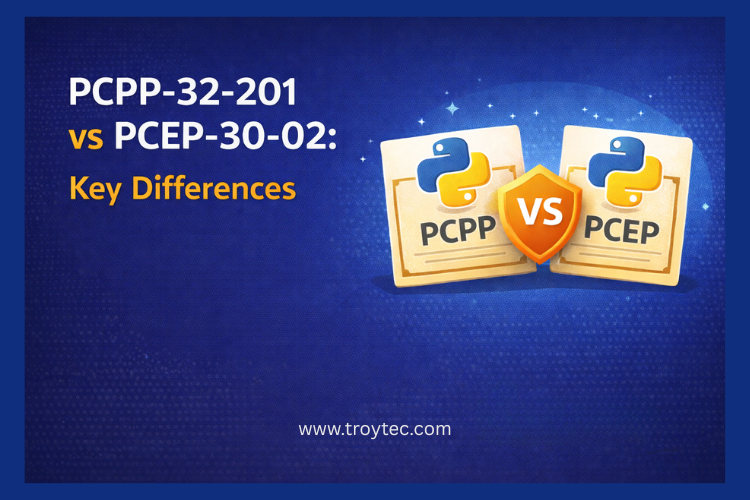
The level of proficiency required is the sole difference between PCEP-30-02 and PCPP-32-201. This certification is meant for beginners and stresses basic programming concepts. On the other hand, PCPP or Certified Professional in Python Programming 1 Exam is a challenging certification requiring a thorough knowledge of Python as well as hands-on programming experience.
This difference is crucial because it enables you to have reasonable expectations. Without a solid foundation, attempting an advanced certification might result in failure and frustration. You can gain confidence by beginning with this entry-level certification and working your way up to more advanced certificates just like PCAP or Certified Associate in Python Programming Exam.
Certified Entry-Level Python Programmer Exam Syllabus
Here is the Python Institute PCEP certification syllabus you must prepare before taking the exam:
1. Python Fundamentals and Computer Programming (18%)
· Recognize basic terminology and concepts.
- Compiling and the compiler, interpreting and the interpreter
- Semantics, syntax, and lexicon
· Recognize the structure and logic of Python
- Keywords
- Instructions
- Indentation
- Remarks
· Use several numeric systems and include literals and variables in the code.
- Boolean, floating-point, and integer numbers
- Scientific notation
- Strings
- The number systems of binary, octal, decimal, and hexadecimal
- Variables
- Conventions for naming
- Putting PEP-8 proposals into practice
· Select data types and operators that are appropriate for the situation. Numerical operators include ** * / % // + –
- Operators for strings: * +
- Assignment and shortcut operators
- Binary and unary operators
- Priorities and binding
- Bitwise operators: ~ & ^ | << >>
- Boolean operators include not, and, and or.
- Boolean expressions
- Relational operators (== != > >= < <=)
- Casting of types
· Use the input/output console.
- The input() and print() methods
- The arguments for the sep= and end= keywords
- The methods float() and int()
2. Conditional Blocks and Loops in Control Flow (29%)
· Make choices and use the if instruction to branch the flow.
- Conditional statements include if, if-else, if-elif, and if-elif-else.
- Several conditional expressions
- Conditional statement nesting
· Conduct several kinds of iterations.
- The directive to pass
- Constructing loops with range(), while, for, and in
- Repeating sequences
- Using while-else and for-else to widen loops
- Conditional statements and stacking loops
- Using break and continue to manage loop execution (Most important for PCEP)
Also Read: IT Certification Jobs: Ultimate Guide to High-Paying Careers
3. Data Collections: Lists, Strings, Tuples, and Dictionaries (25%)
· Gather and use lists to process data
- Building vectors
- Slicing and indexing
- The len() function
- List methods include append(), insert(), index(), and so forth.
- functions: sorted(), len()
- The del instruction
- Using the for loop to iterate over lists
- Setting up loops
- The operators that are in and not in
- List comprehension
- Cloning and copying
- Lists within lists: cubes and matrices
· Use tuples to gather and handle data
- Tuples: immutability, constructing, slicing, and indexing
- Lists and tuples: similarities and differences
- Tuples within lists and lists inside tuples
· Use dictionaries to gather and interpret data
- Building, indexing, adding, and deleting keys in dictionaries
- Iterating over dictionaries, their values, and keys
- Verifying the presence of keys
- methods: values(), keys(), and items()
· Use strings
- Building strings
- Slicing, indexing, and immutability
- Using the \ character to escape
- Quotations and apostrophes within strings
- Strings with many lines
- Basic methods and functions for strings
4. Exceptions and Functions (28%)
· Use functions to break down the code.
- Creating and using user-defined generators and functions
- Returning results with the return keyword
- The None keyword
- Recursion
· Plan how the function and its surroundings interact.
- Arguments versus parameters
- Positional, keyword, and mixed argument passing
- The default values of the parameters
- The global keyword, name scopes, and name concealing (shadowing)
· The Hierarchy of Built-In Exceptions in Python
- Base Exception
- An exception
- System Exit
- Keyboard Interrupt
· Abstract exceptions
- The Arithmetic Error
- Lookup Error
- Index Error
- Key Error
- Type Error
- Value Error
· Python Exception Handling Fundamentals
- Try-except and the try-except Exception
- Sorting the branches with the Exception
- Exception propagation across function boundaries
- Assigning accountability for managing exceptions
We advise taking an authorized PCEP prep course, taking a practice test, and gaining practical experience to prepare for the Python Institute Certified Entry-Level Python Programmer Exam.
PCEP Training vs. PCEP Prep Course vs. Self-Study
Not all PCEP preparation paths look the same, and picking the right one depends on your learning style and timeline. Here’s how the main options compare:
| Preparation Path | Best For | Typical Duration | Format |
|---|---|---|---|
| PCEP Training Course | Complete beginners with no prior Python exposure | 3–6 weeks | Video lessons + guided exercises |
| PCEP Prep Course | Candidates who know basic Python and want exam-focused review | 1–2 weeks | Structured modules + timed practice |
| Self-Study + Practice Tests | Confident self-learners on a budget | Flexible | PDF study guide + Test Engine |
Whichever path you choose, pairing it with a PCEP-30-02 practice test from Troytec closes the gap between “knowing the material” and “passing under exam conditions.”
Is Python Institute Certification Useful?
Why the certification is truly worthwhile is one of the most often asked topics by novices. Yes, but there is some background.
Beginners who wish to acquire confidence and prove their abilities may find the Python Institute Certified Entry-Level Python Programmer certification very helpful. Additionally, it can enhance your CV and increase your appeal to companies, particularly if you’re searching for entry-level positions.
But it’s crucial to realize that certification is insufficient on its own. Employers highly value real-world experience and practical abilities. As a result, you should incorporate practical tasks and ongoing education with your certification.
After completing PCEP, candidates can compare the best programming certifications to decide whether PCAP, PCPP, or another coding credential fits their career goals.
Top 7 Strategies to Pass the PCEP Certification Exam
Here are the proven strategies to pass this certification on your first attempt:
1. Recognize The Goals Of The Test
Examine and comprehend the subjects contained in the official Certified Entry-Level Python Programmer syllabus. Give priority to important areas such as data collecting, loops, and control flow. Exam questions from the past might also provide information about topics that are examined regularly.
2. Complete The PCEP Practice Exams
Regularly taking a PCEP practice test can help you become acquainted with the format and time limits of the exam. Excellent practice tests are available on websites such as Troytec. You may significantly raise your score by monitoring your development and concentrating on your areas of weakness.
3. Learn The Fundamentals Of Python
Make sure you understand data types, fundamental operations, and Python syntax. Interactive coding platforms and the Python Institute are examples of helpful online tools. You may strengthen your grasp of the basics by doing little coding activities every day.
4. Pay Attention To Code Execution
Practice developing and executing Python scripts because the examination assesses practical expertise. Learn how to optimize and troubleshoot your code. You may test and comprehend functions on the fly by using an interactive Python shell.
5. Study Loops And Conditional Statements
Control flow is covered in around 29% of the Certified Entry-Level Python Programmer test. To ace this section, become proficient with conditional expressions, loops (for, while), and if-else statements. Hands-on skills can be enhanced by writing tiny projects that use conditional statements and loops.
6. Expand Your Understanding Of Data Collection
In Python, lists, tuples, dictionaries, and strings are essential. Verify your ability to work effectively with these data structures. To improve your problem-solving skills, try resolving typical code issues using these structures.
7. Examine Exceptions And Functions
Exception handling and Python functions account for 28% of the test. Discover how to construct functions properly, utilize arguments, return values, and deal with exceptions. It would be helpful to comprehend built-in features and their applications.
PCEP Study Guide: How to Structure Your Prep
A good PCEP study guide should map directly to the four syllabus domains rather than treating Python as one big topic. Here’s a simple week-by-week structure you can follow:
- Week 1 — Fundamentals (18%): Syntax, variables, numeric systems, operators, input/output
- Week 2 — Control Flow (29%): Conditional statements, loops, break/continue logic
- Week 3 — Data Collections (25%): Lists, tuples, dictionaries, strings
- Week 4 — Functions & Exceptions (28%): Function design, scope, exception hierarchy, error handling
Spend the final few days before your exam exclusively on timed practice tests rather than new material — this is where most of the first-attempt pass rate improvement comes from.
Download Latest PCEP Practice Tests
One of the most effective strategies for passing the PCEP exam is taking practice exams. They not only assist you with assessing your knowledge but also help you mentally get ready for the test setting.
You may obtain a good sense of the kinds of questions that might be on the test by taking current practice exams. This boosts confidence and lessens worry. But not all practice materials are trustworthy. You may be misled by the fact that many so-called PCEP question dumps that are accessible online are out-of-date or inaccurate.
The best course of action is to use verified, revised practice exams from Troytec.com that closely match the most recent test format. These evaluations ought to be added to coding practice and regular revision.
Quickly Pass the Certified Entry-Level Python Programmer Exam: Resources and Resources
Using the appropriate resources can significantly impact your ability to pass the Certified Entry-Level Python Programmer test fast and effectively.
Here are the Available resources:
- Downloadable PDFs: Thorough study guides covering every subject on the test
- Online Test Engine Practice: Timed exams in a real exam simulation
- Practice Questions Database: Updated questions that match the format of the 2026 test
- PCEP Prep Course: Structured education using activities and video tutorials
Conclusion
Obtaining the PCEP certification validates your proficiency with Python and gets you ready for professional Python development positions and advanced qualifications like PCAP.
A fulfilling accomplishment that can lay the groundwork for a prosperous career in Python programming is earning Certified Entry-Level Python Programmer certification. You may successfully pass the Certified Entry-Level Python Programmer certification exam and advance your programming career by using these seven crucial pointers, completing a Certified Entry-Level Python Programmer practice test from Troytec, and utilizing top-notch study resources.

Pingback: