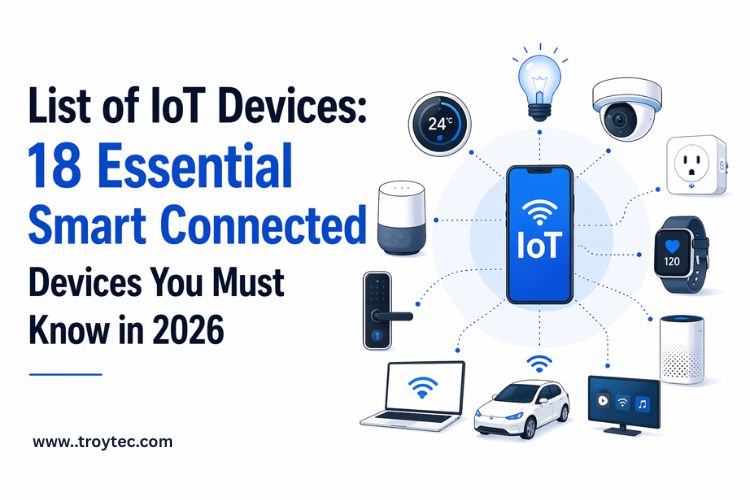

If you are searching for a complete list of IoT devices, this guide is the most comprehensive list of IoT devices you will find online.The Internet of Things (IoT) is a collective term for billions of physical objects connected to the Internet, sharing and exchanging data with other devices and systems. This comprehensive list of IoT devices covers everything from everyday smart home gadgets to advanced industrial sensors — the most complete IoT devices list you need in 2026.
IoT devices include hardware such as sensors, actuators, gadgets, appliances, and machines — all programmed for specific applications and capable of sending data over the Internet and other networks. Each device in this list of IoT devices has a unique identifier (UID) that allows it to transmit data without human intervention.
Three key advances have made the growing list of IoT devices far more practical today:
- Affordable and reliable access to sensors
- Increased availability of cloud computing platforms
- Advances in machine learning and AI technology
If you want to build a career around these technologies, explore Cloud Computing Certifications and AI & Machine Learning Exam Prep on TroyTec.
Read Also : Top 6 programming Certifications to Build Strong Coding Skills
What Are the Four Layers of IoT?
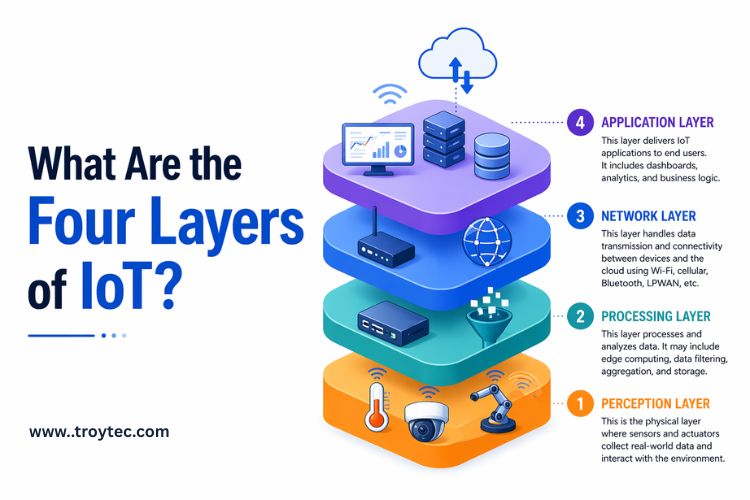
Before diving into the full list of IoT devices, it helps to understand the IoT architecture. The IoT ecosystem is built on four layers:
1. Sensing Layer
Sensors, actuators, and IoT devices reside here. They collect physical or environmental data and transmit it over the network — this is where most IoT enabled devices begin their data journey.
2. Network Layer
This layer hosts the Internet/Network Gateway and Data Acquisition System (DAS). The DAS aggregates data, converts analog sensor signals to digital data, and provides essential gateway functions like malware protection. System engineers working with IoT networks can validate these skills with the 700-821 Cisco IoT Essentials for System Engineers certification on TroyTec.
3. Data Processing Layer
This is the processing core of the IoT ecosystem. Data is analyzed and preprocessed before reaching the data center, where business applications monitor and manage it. Edge IT professionals often hold AWS or Microsoft Azure certifications.
4. Application Layer
The final layer — a cloud or data center — where data is used by end-user applications across agriculture, healthcare, aerospace, and defense.
What Are the 5 Types of Internet of Things? (The Broader List of IoT Devices)
The list of IoT devices spans multiple sectors. Understanding these types helps you better appreciate how wide the IoT devices list truly is:
1. Consumer IoT (CIoT)
Covers smartphones, wearables, smart assistants, and home appliances. CIoT solutions use Wi-Fi, Bluetooth, and ZigBee for short-range connectivity. Wireless IoT professionals can earn the CWISA-102 Certified Wireless IoT Solutions Administrator certification on TroyTec.
2. Commercial IoT
Brings IoT benefits to offices, supermarkets, hotels, and medical facilities — improving customer experience and reducing utility costs. Account managers can prepare for the 700-846 Cisco IoT Advantage for Account Managers exam on TroyTec.
3. Industrial IoT (IIoT)
Focused on improving efficiency in factories, manufacturing plants, healthcare, agriculture, automotive, and logistics. IIoT is one of the fastest-growing segments of the internet of things devices market.
4. Infrastructure IoT
Involves monitoring urban and rural infrastructure — bridges, railroad tracks, and offshore wind farms — improving efficiency and reducing maintenance costs.
5. Military IoT (IoMT)
Also called Battlefield IoT, IoMT connects ships, planes, tanks, soldiers, and drones through interconnected systems to improve situational awareness and response time.
Why Is the List of IoT Devices So Important?
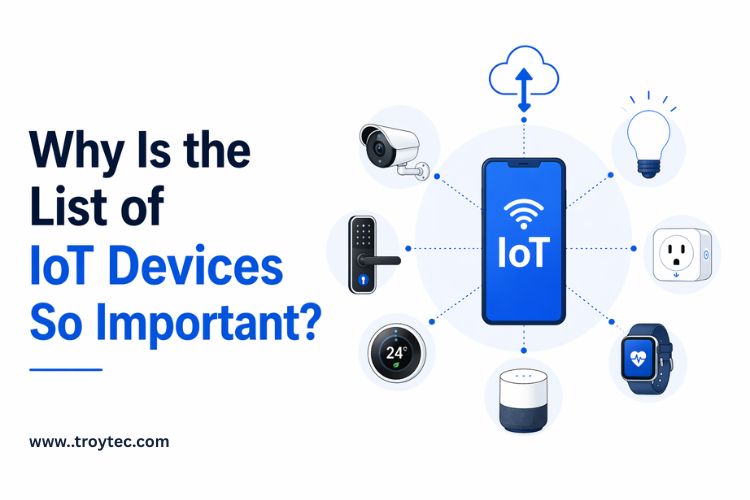
Understanding the importance of a comprehensive list of IoT devices is essential for navigating the future of technology. The IoT bridges the physical and digital worlds, enabling organizations to automate operations and make data-driven decisions. Key benefits include:
- Improved decision-making through real-time IoT data insights
- Increased productivity and operational efficiency
- New business models and income streams
- Enhanced customer experience across industries
IoT-related roles are among the fastest-growing in tech. Read the IT Certification Jobs: Ultimate Guide to High-Paying Careers on TroyTec to discover which certifications open the best doors.
Complete List of IoT Devices: 18 Smart Connected Devices
Here is the complete IoT device list covering 18 smart connected devices you should know. This list of IoT devices spans consumer gadgets, security systems, health monitors, and industrial sensors. Every item on this IoT devices list plays a unique role in the connected ecosystem.
1. Google Home Voice Controller
One of the most widely used smart home IoT devices, Google Home lets users control media, lights, thermostats, and alarms entirely by voice. Key features:
- Control TV, speakers, timers, and alarms hands-free
- Manage smart home lights and appliances remotely
- Plan your day automatically with Google Assistant
CWISA-102 Certified Wireless IoT Solutions Administrator Exam
2. Amazon Echo Plus
A popular consumer IoT device, Amazon Echo Plus offers voice-enabled calling, music playback, alarms, weather updates, and smart home control. Features:
- 6–7 directional microphones with noise cancellation
- Connect to external speakers or headphones
- Control compatible smart home devices like lights and plugs
700-846 Cisco IoT Advantage for Account Managers Exam
3. August Doorbell Cam
A practical IoT security device that lets you monitor and answer your door from anywhere in the world. Features:
- Pairs with August Smart Locks for seamless guest access
- Full-color HD video with integrated floodlights
- 24-hour free video recording with instant motion alerts
CWNA-109 Certified Wireless IoT Design Professional Exam
4. August Smart Lock
A dependable connected security device that lets users manage door access remotely without a physical key. Features:
- Auto-unlock when the user arrives near the entrance
- Unlimited digital keys — no more worrying about key theft
- Easy installation on standard single-cylinder deadbolts
5. Foobot Indoor Air Quality Monitor
Foobot is an IoT sensor device that accurately measures indoor air pollution and improves air quality in homes, offices, and public spaces. Features:
- Monitors humidity, temperature, and pollution levels in real time
- Helps improve concentration and well-being through cleaner air
- Quick and straightforward installation process
700-821 Cisco IoT Essentials for System Engineers Exam
6. Nest Learning Thermostat
One of the most recognizable IoT enabled devices for home energy management. The Nest thermostat learns your temperature preferences over time and automatically adjusts to save energy. Features:
- Learns your schedule and programs itself within a week
- Can be controlled remotely via smartphone app
- Reports home energy usage to help reduce electricity bills
- Compatible with most home heating and cooling systems
7. Fitbit Health & Fitness Tracker
Fitbit is one of the most well-known wearable IoT devices on the market. It tracks physical activity, sleep patterns, heart rate, and more. Features:
- 24/7 heart rate and SpO2 blood oxygen monitoring
- Sleep tracking with detailed nightly reports
- Step counting, calorie tracking, and workout detection
- Syncs data to smartphone for health trend analysis
8. Philips Hue Smart Lighting
Philips Hue is a leading IoT device for smart home lighting. It lets users control the color, brightness, and scheduling of lights through an app or voice assistant. Features:
- 16 million color options controllable via app or voice
- Set schedules, scenes, and automations
- Compatible with Google Home, Amazon Alexa, and Apple HomeKit
- Motion sensor integration for hands-free lighting control
9. Ring Video Doorbell
Ring is a widely adopted IoT security device that lets homeowners see, hear, and speak to visitors from anywhere. Features:
- HD video with night vision and two-way audio
- Real-time motion alerts sent to your smartphone
- Cloud video recording with optional subscription
- Integrates with Amazon Alexa for voice announcements
10. Smart Refrigerator (Samsung Family Hub)
The Samsung Family Hub is one of the most advanced IoT devices for the kitchen. It connects to the Internet to help manage groceries, recipes, and family schedules. Features:
- Internal cameras let you see fridge contents remotely
- Suggests recipes based on available ingredients
- Touch screen display for family notes and calendars
- Compatible with other Samsung smart home devices
11. Amazon Dash Replenishment
Amazon Dash is a smart IoT device built into appliances like washing machines and printers. It automatically reorders supplies — detergent, ink, or filters — before they run out. Features:
- Automatic supply reordering when levels run low
- Built into hundreds of compatible appliances and devices
- Saves time and prevents running out of essentials
12. Industrial IoT Sensors (Predictive Maintenance)
Industrial IoT sensors are critical IoT enabled devices used in manufacturing plants, oil rigs, and power stations. They monitor machine health in real time to prevent costly breakdowns. Features:
- Monitor vibration, temperature, and pressure continuously
- Predict equipment failures before they happen
- Reduce downtime and maintenance costs significantly
- Transmit data to cloud dashboards for analysis
13. Smart Water Meter
Smart water meters are IoT devices used in smart cities and homes to monitor water usage in real time, detect leaks, and reduce waste. Features:
- Real-time water usage monitoring via app
- Automatic leak detection and alert notifications
- Helps reduce water bills and environmental waste
- Used in municipal infrastructure IoT deployments
14. Connected Car (OBD IoT Device)
OBD (On-Board Diagnostics) IoT devices plug into your car and turn it into a connected vehicle. They monitor engine health, driving behavior, and location. Features:
- Real-time engine diagnostics and fault code reading
- GPS tracking and trip history logging
- Driver behavior scoring for insurance savings
- Roadside assistance alerts triggered automatically
15. Smart Agriculture Sensor
Smart agriculture sensors are IoT enabled devices used to monitor soil conditions, weather, and crop health. With the world population expected to reach 10 billion by 2050, these devices are vital for sustainable farming. Features:
- Monitor soil moisture, pH, temperature, and humidity
- Automate irrigation systems based on real-time data
- Reduce water and fertilizer waste significantly
- Send data to cloud dashboards for farmer decision-making
16. Medical IoT Device — Guardian Glucose Monitor
The Guardian Glucose Monitoring Device is a healthcare IoT device that helps people with diabetes track their blood sugar levels continuously without manual testing. Features:
- Glucose sensor placed under the skin for continuous monitoring
- Transmits readings to surveillance devices via radio frequency
- Sends alerts when glucose levels go too high or too low
- Reduces need for traditional finger-prick blood tests
17. Smart Street Light
Smart street lights are infrastructure IoT devices used in smart cities to reduce energy costs and improve public safety. Features:
- Automatically dim or brighten based on pedestrian presence
- Report faults and outages to city management systems
- Reduce municipal energy consumption by up to 50%
- Can integrate with traffic and surveillance systems
18. Drone (Unmanned Aerial IoT Device)
Commercial drones are increasingly part of the IoT device list used in agriculture, logistics, surveillance, and disaster response. Features:
- Real-time video streaming and aerial data collection
- GPS-guided autonomous flight paths
- Used in agriculture for crop monitoring and spraying
- Deployed in military and disaster relief operations
IoT Devices Examples Across Industries
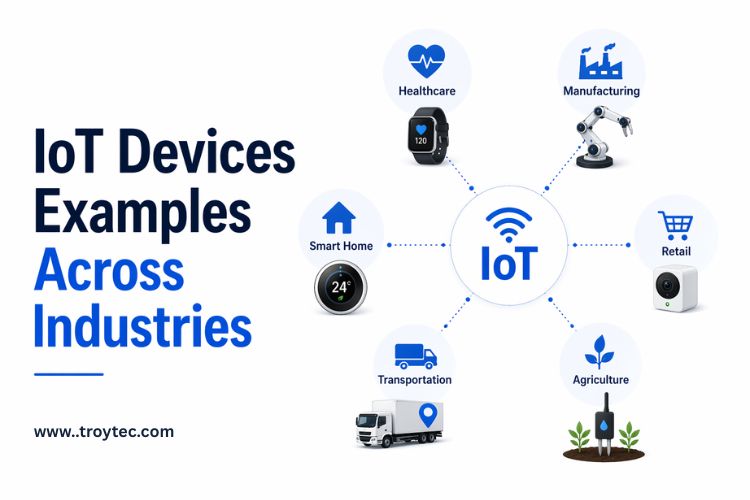
Beyond the core list of IoT devices above, here are real-world IoT devices examples by industry. This section of the list of IoT devices shows how broadly connected devices are deployed globally:
Smart Home Examples:
- Smart thermostats (Nest, Ecobee)
- Voice assistants (Amazon Echo, Google Home)
- Smart locks and doorbells (August, Ring)
- Smart lighting (Philips Hue, LIFX)
Healthcare IoT Examples:
- Continuous glucose monitors (Guardian, Dexcom)
- Remote patient monitoring devices
- Smart inhalers for asthma tracking
- Wearable ECG and heart rate monitors
Industrial IoT Examples:
- Predictive maintenance sensors in factories
- Supply chain tracking using RFID and GPS
- Automated robotic arms on assembly lines
- Environmental monitoring in oil and gas plants
Smart City IoT Examples:
- Smart parking sensors (like Palo Alto, San Francisco)
- Connected traffic management systems
- Smart water meters and waste management sensors
- Air quality monitoring stations
Agriculture IoT Examples:
- Soil moisture and weather sensors
- Smart greenhouse climate control systems
- Livestock health tracking wearables
- Drone-based crop monitoring and spraying
FAQs
What is an IoT device?
An IoT device is any physical object embedded with sensors, software, and connectivity that allows it to collect and exchange data over the Internet without requiring human interaction. Examples range from smart home gadgets to industrial machinery sensors.
What are some objects besides computers that can be connected to the Internet?
Many everyday objects can be connected to the Internet as IoT devices. Common examples include: smart TVs, refrigerators, thermostats, door locks, streetlights, cars, medical monitors, agricultural sensors, wearable fitness trackers, drones, and even household appliances like washing machines. Essentially, any object that can embed a sensor and a wireless chip can become an IoT enabled device.
What are the most popular IoT devices?
The most popular IoT devices today include Google Home, Amazon Echo, Nest Thermostat, Ring Doorbell, Fitbit, Philips Hue, and August Smart Lock. In industrial settings, predictive maintenance sensors and smart meters are the most widely deployed IoT enabled devices.
What is the difference between IoT devices and regular devices?
Regular devices operate independently without Internet connectivity. IoT devices are specifically designed to connect to the Internet or other networks, collect data through sensors, and communicate that data to other systems — often without any human input.
How many IoT devices exist in the world?
As of 2026, there are estimated to be over 16 billion active IoT connected devices worldwide, with that number expected to grow to over 25 billion by 2030 as smart home, industrial, and infrastructure IoT adoption accelerates globally.
Are IoT devices secure?
IoT device security varies widely. Many consumer IoT devices have limited built-in security, making them vulnerable to attacks if not properly configured. Best practices include changing default passwords, keeping firmware updated, and using network segmentation. Professionals managing enterprise IoT networks often hold cybersecurity certifications to handle these risks.
Want to Work in IoT? Get Certified First
The IoT industry is expanding fast and employers are actively seeking certified professionals in networking, cloud computing, and cybersecurity. Whether you are interested in consumer IoT, industrial IoT, or smart city infrastructure, the right certification can fast-track your career.
TroyTec offers 500+ IT certification practice exams to help you pass on the first try. Browse certifications including:
- 700-821 Cisco IoT Essentials for System Engineers
- CWISA-102 Certified Wireless IoT Solutions Administrator
- 700-846 Cisco IoT Advantage for Account Managers
- AWS, Azure, and Google Cloud certifications
Also check out the High-Paying IT Certification Jobs across the IoT industry.
