

Yes, you can get a cybersecurity job with only CompTIA Security+ in 2026, especially if you are targeting entry level cybersecurity jobs. While Security+ alone may not immediately qualify you for senior security roles, it is still one of the most recognized beginner cybersecurity certifications for launching a career in cybersecurity.
Introduction
Breaking into cybersecurity might be frightening, especially if you’re concerned about a lack of expertise. Fortunately, a cybersecurity job is one of the few IT professions with clear entry-level paths, high demand, and companies that respect education and credentials alongside practical experience. For dedicated learners, cybersecurity is one of the most accessible technological occupations. CompTIA Security+ jobs are booming in the employment sector as the demand has increased for Security+ professionals in 2026.
If you like puzzle-solving, working in dynamic workplaces, and defending individuals and businesses from digital threats, cybersecurity might be a good fit for you. Furthermore, cybersecurity professions are often well-rewarded, particularly in early career phases. Average earnings often vary between $75,000 and $100,000, depending on the function and expertise.
Keep reading and exploring to learn about entry level cybersecurity jobs you can get with Security+ certification and other jobs in cybersecurity.
What is Cybersecurity?

Cybersecurity is the process of protecting a computer system from potential theft, damage, and unauthorized access to networks, electronic equipment, and personal information.
It consists of a set of tools, processes, and rules intended to protect digital assets and defend against cyberattacks. Cybersecurity is primarily concerned with maintaining the safety, security, and accessibility of information and systems.
To protect themselves, organizations and individuals must be vigilant for more complicated cyber-attacks. Firewalls, antivirus applications, encryption, limited access lists, detection and prevention systems, and vulnerability assessments are all examples of cybersecurity measures.
An optimum cybersecurity plan should include many layers of defense on all conceivable access points and attack surfaces. This provides a layer of protection for the linked networks, hardware, software, and data.
Everyone at a corporation who has access to any of these locations should be trained on the proper security and compliance processes. There is the best cybersecurity job available that will make you a useful employee in any firm.
Why Is Cybersecurity a Good Career Choice?

Cybersecurity, often known as information security, has rapidly become a top responsibility for businesses and organizations of all kinds. As cyber risks like data breaches and ransomware attacks increase, the demand for competent cybersecurity personnel significantly outstrips the supply.
According to the Bureau of Labor Statistics in the US (BLS), jobs of information security analysts are expected to expand by 29% between 2024 and 2034, substantially faster than the average for all occupations. This significant rise mirrors a larger worldwide cybersecurity skills gap, with millions of positions vacant due to a dearth of trained people.
As enterprises increasingly utilize cloud services, tech remote jobs, and digital infrastructure, the demand for cybersecurity skills is projected to grow.
For fresh graduates and career changers, this need frequently translates into high employment stability, high starting wages, and career options in fields such as technology, education, finance, healthcare, and government.
However, in order to obtain beginner cybersecurity job, you must first complete the necessary schooling. Cybersecurity degree programs often include courses in system and network security, risk administration, digital forensics, scripting and programming, and safe web development.
Cybersecurity vs CompTIA: What’s the Difference and Which Is Better for Your Career?
- Cybersecurity is a vast technical subject that focuses on defending systems, networks, and data from cyber threats and assaults.
- CompTIA is a worldwide known source of IT certifications such as CompTIA Security+, CompTIA CySA+, and Network+ for cybersecurity and IT professionals.
From this quick table, you will understand what the main difference between cybersecurity and CompTIA is, and which is a better choice for your security career.
| Factor | Cybersecurity | CompTIA |
|---|---|---|
| Definition | Career field focused on digital security. | Certification organization for IT and cybersecurity. |
| Main Purpose | Protect systems, networks, and data. | Validate technical IT and security skills. |
| Scope | Includes networking, cloud, ethical hacking, SOC, and more. | Offers entry-level to advanced certifications. |
| Career Impact | Leads to cybersecurity job roles. | Helps qualify for cybersecurity jobs. |
| Learning Focus | Practical security concepts and defense strategies. | Structured certification-based learning. |
| Popular Roles | Security Analyst, SOC Analyst, Ethical Hacker. | Security+, CySA+, PenTest+ certified professional. |
| Industry Recognition | High-demand global career field. | Widely recognized certification brand. |
| Best For | People pursuing security careers. | Individuals seeking IT/security certifications. |
Is Security+ Enough To Get a Cybersecurity Job?
Absolutely! CompTIA Security+ certification is a popular choice among businesses for entry-level employment. While certain positions may require more experience or certifications, Security+ proves that you have the fundamental skills to begin your cybersecurity career successfully.
Why Security+ Is A Strong Starting Point?
- Industry Standard: It is well-known and commonly required for entry-level employment.
- Fundamental Knowledge: Covers basic security concepts such as network security, threat leadership, and risk identification.
- Compliance: Meets the government and company criteria for fundamental security knowledge.
Why CompTIA Security+ is Still Relevant in 2026?
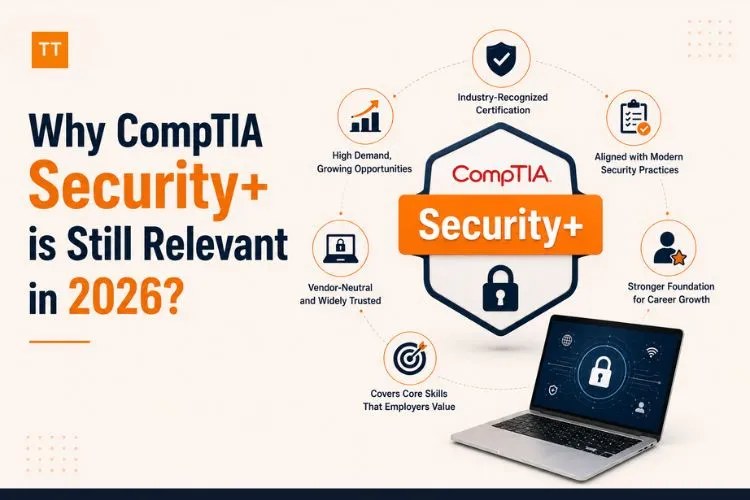
CompTIA Security+ is one of the most regarded certifications for entry-level cybersecurity employment because it certifies fundamental cybersecurity skills without demanding years of professional experience.
Unlike advanced certificates, which focus on specialized areas, Security+ covers a wide spectrum of security ideas, making it perfect for those new to the cybersecurity field.
What Security+ Covers?
This certification focuses on:
- Network Security
- Threat detection
- Risk management
- Security operations
- Identity management
- Cryptography
- Vulnerability management
- Incident reaction
Security+ comprehensive understanding makes it suitable for a variety of entry-level cybersecurity careers.
CompTIA Security+ Certification Study Plan, Jobs & Salary Guide
Why Employers Value Security+?
Many firms utilize Security+ cybersecurity job as a recruiting criterion since it shows that candidates grasp fundamental cybersecurity concepts.
Government agencies, defense companies, managed service companies, healthcare organizations, and business IT departments frequently accept Security+ as an authorized baseline certification.
In many circumstances, recruiters look for:
- CompTIA Security+ Jobs
- Security+ certification jobs
- Beginner cybersecurity jobs.
- Entry level cybersecurity employment.
Security+ is vendor-neutral, so the skills taught may be applied to a variety of systems and contexts.
5 Entry-Level Cybersecurity Jobs You Can Get With Security+
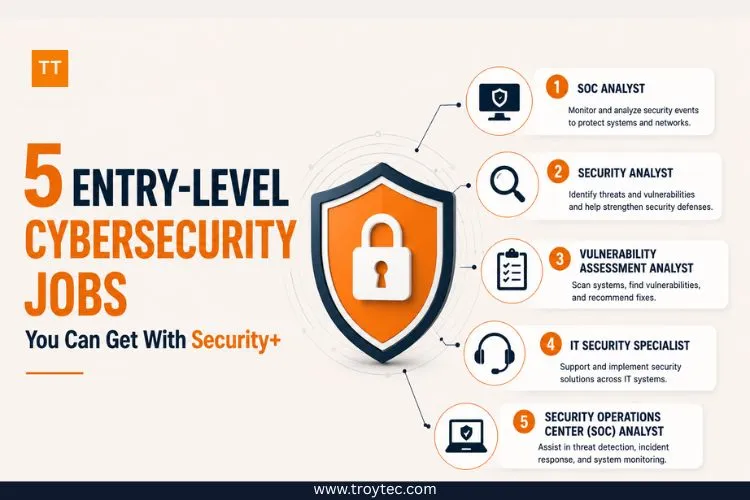
One of the most significant benefits of Security+ is that it provides the best access to a wide range of entry level cybersecurity jobs.
The following are some of the most popular security+ jobs for beginners accessible in 2026:
1. SOC Analyst
A SOC Analyst, which is additionally known as a Security Operations Center Analyst, is a common entry-level cybersecurity profession for those with a CompTIA Security+ certification.
This position involves monitoring networks, systems, and security technologies to detect unusual behavior and respond to possible cyber-attacks before they do harm.
Many corporations recruit novice SOC analysts because enterprises increasingly require 24-hour monitoring for ransomware, phishing assaults, malware infections, and illicit access attempts.
SOC analysts frequently use technologies to generate security alerts, evaluate odd login attempts, assess suspected network behavior, and escalate concerns to higher security teams as appropriate.
The position is perfect for beginners since it gives hands-on cybersecurity knowledge and experience in active security incidents. Among all security+ careers for beginners, a SOC Analyst remains one of the best starting places for long-term career advancement in cybersecurity.
Can I Get a SOC Analyst Job With Security+ Only?
Yes, many organizations recruit junior SOC analysts who just have Security+ certification and basic technical skills.
SOC analysts is the best cybersecurity job which monitors systems for unusual behavior, examine alarms, and respond to security events.
Key Skill Required
To be successful as a SOC Analyst, novices need to develop:
- Networking Fundamentals
- SIEM tool familiarity.
- Basic Linux and Windows knowledge
- Ability to identify threats
- Understanding the incident reaction.
- Analytical thought
- Communication and documentation capabilities.
Average Salary
The typical compensation for entry-level SOC Analysts might range from:
- Average $55,000 to $85,000 annually in the United States.
- Higher wages in the business and government sectors
- Remote SOC employment may provide attractive remuneration packages.
2. Security Analyst/Manager.
Security analysts are critical in preventing hostile actors from altering, accessing, or deleting firm data. The analyst’s task is to identify and correct flaws in the existing security systems. They typically work with other departments to develop new methods.
Analysts use the obtained data to detect suspect activity on databases, computer networks, computers, or other proprietary software. Analysts take the lead in preventing future attacks and mitigating the damage of a breach.
Key Skill Required
Security analysts must have the following important skills:
- Risk analysis
- Security monitoring
- Vulnerability assessment
- Basic scripting knowledge.
- Networking Fundamentals
- Communication skills
- Problem-solving skills
Average Salary
Entry-level security analysts can earn:
- $60,000 to $90,000 yearly.
- Higher pay in banking, healthcare, and cloud security
- Additional bonuses in industrial companies.
3. IT Security Specialist
An IT Security Specialist is responsible for securing an organization’s IT infrastructure, systems, devices, and networks against cyber-attacks. This position combines traditional IT skills with cybersecurity duties, making it a good choice for those looking for the best entry level cybersecurity job after attaining Security+.
Many firms engage junior IT security professionals to assist in maintaining safe systems, administer endpoint protection, set up firewalls, and support security compliance efforts.
CompTIA Security+ is an excellent fit for this position since it teaches fundamental security principles utilized on a daily basis in IT security operations. Candidates who comprehend network security support, access control, risk mitigation, and security best practices are frequently evaluated for entry-level cybersecurity positions in this area.
Key Skill Required
Candidates need to develop:
- Windows and Linux administration
- Firewall management
- Endpoint security knowledge
- Troubleshooting skills
- Risk management basics
- Communication skills
- Technical documentation skills.
Average Salary
Junior IT Security Specialists could earn:
- $58,000 to $88,000 each year.
- Higher pay in business contexts.
- Additional advantages for hybrid or distant roles.
4. Junior Penetration Tester
A Junior Penetration Tester is responsible for assisting enterprises in identifying system vulnerabilities before hostile intruders exploit them.
Penetration testing, often known as ethical hacking, simulates cyberattacks to assess the security of apps, networks, servers, and corporate infrastructure.
While many advanced penetration testing positions demand experience, certain entry-level cybersecurity positions are accessible to younger individuals with certifications such as CompTIA Security+.
Security+ teaches fundamental cybersecurity information for prospective penetration testers, including networking, vulnerabilities, threat administration, and security operations.
Although Security+ alone cannot guarantee a penetration testing position, it provides a solid foundation for those pursuing a offensive cybersecurity job.
Key Skill Required
Helpful skills include:
- Linux Fundamentals
- Networking knowledge
- Basic Scripting
- Web Security Concepts
- Problem-solving skills
- Experience with ethical hacking tools.
- Curiosity and analytical thought
Average Salary
Entry-level Junior Penetration Testers can earn:
- $65,000 to $95,000 yearly.
- Higher pay in consulting companies and enterprise contexts.
- Increased earnings through offensive security certifications
5. Network Support Technician
A Network Support Technician is one of the most underappreciated yet crucial entry-level cybersecurity positions for applicants starting their IT and cybersecurity careers.
Many cybersecurity specialists start out in networking or technical support roles before moving on to specific cybersecurity employment.
This role is responsible for maintaining network connectivity, addressing infrastructure issues, and ensuring that systems interact safely and effectively. If you are wondering, “What jobs can I get after Security+?,” this is the best cybersecurity job you can get after getting the Security+ certification.
CompTIA Security+ helps Network Support Technicians because cybersecurity requires their understanding of network security. The certification establishes basic knowledge requirements which include firewalls and VPNs and routing and access controls and network security.
Key Skill Required
Important skills include:
- TCP/IP Networking
- Troubleshooting ability
- Router and switch setup
- VPN knowledge
- Communication skills
- Technical support expertise
- Basic cybersecurity understanding
Average Salary
Entry-level network support technicians can earn:
- $50,000 to $75,000 yearly.
- Higher pay in cloud-focused firms.
IT Certification Jobs for Achieving Career Success
Explore Troytec IT certification job →
How Can I Get A Job In The Cybersecurity Entry Level?
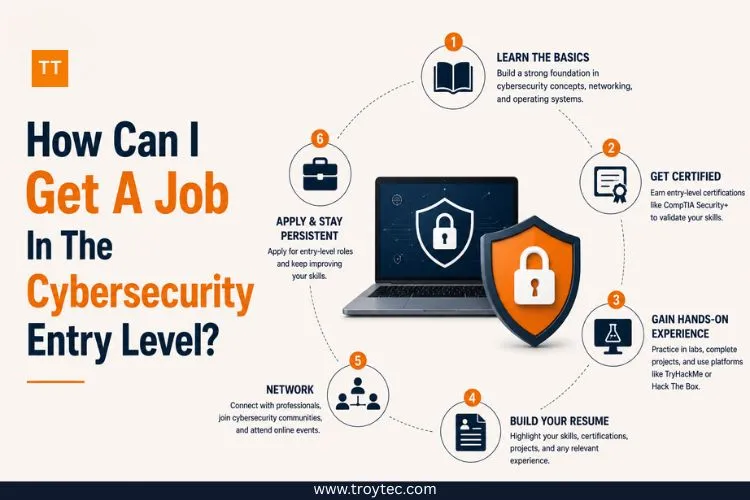
Finding the top entry level cybersecurity jobs begins with analyzing your current skill set. When creating your CV, remember to comprise soft skills in count to technical ones, such as communication, adaptability, conflict resolution, time management, and organizational abilities.
Enrolling in a boot camp can provide those who require further training or upskilling opportunities to gain in-demand skills in a hands-on, project-based learning setting.
To get a job with the CompTIA Security+ certification, you should have some expertise in entry-level IT and cybersecurity tasks, as well as professional relationships. Also, consider upgrading your resume with your accomplishments and preparing mock interview questions.
-
Build Experience
Certifications might help you stand out to employers, but having real-world experience practicing and exhibiting cybersecurity abilities can also help you get the job you desire.
-
Networking
Consider networking with other cybersecurity experts, either online or in person, to learn about career opportunities that match your qualifications.
-
Update Your CV And Prepare For Interviews
Tailor it to the cybersecurity job you desire by examining the job description and showcasing your own talents that are relevant to it. Then, make a list of questions to ask during your interview to demonstrate how much study and learning you’ve done about the organization beforehand.
Conclusion
The Security+ certification gives you access to intriguing and a profitable cybersecurity job. There has never been a better moment to enter this sector, with high job market demand, attractive compensation, and obvious chances for promotion. To differentiate yourself from competitors, combine your qualifications with practical skills, networking, and hands-on experience.
If any of the above-mentioned entry-level cybersecurity positions sound attractive, now is the time to take the next step. Demand is high, incomes are competitive, and firms from all industries want qualified people.
FAQs (Frequently Asked Questions)
Q2 : Can You Get A Cybersecurity Job With Only Security+?
Q3 : Is CompTIA Security+ Enough For Beginners In Cybersecurity?
Yes, Security+ is one of the finest starting certifications since it covers fundamental cybersecurity principles and prepares students for entry-level roles.
