
Glossary
The MLA-C01 certification validates a professional’s ability to design, build, and deploy machine learning solutions on the AWS cloud. It focuses on key areas such as data engineering, model training, feature engineering, and ML deployment using services like Amazon SageMaker, S3, and AWS Glue. The certification is meant for developers, cloud engineers, and data professionals who wish to prove real-world proficiency in creating scalable machine learning pipelines and handling ML workloads inside the AWS ecosystem.
Introduction
AWS certifications are among the most valuable and difficult to obtain in IT. Each is challenging, but the MLA-C01 exam has a “special sauce.” It evaluates your conceptual understanding of machine learning, statistics, and probability, as well as your familiarity with AWS.
The machine learning MLA C01 Exam is a well-recognized machine learning certification. However, if you wish to take the exam, it is not as easy as it looks. You must prepare well because the exam is really challenging. Therefore, we are here to discuss special tips to pass the AWS MLA C01 exam easily in 2026.
We aim to help you pass the AWS MLA C01 test. You can easily pass the AWS Certified Machine Learning Engineer with the aid of our online preparation platform, which provides MLA C01 practice exams. Our team of experts created this practice test based on their knowledge of AWS technology and their more than ten years of experience in the specialty domain.
Keep reading and exploring to learn the most important topics of the MLA C01 exam you must not ignore if you want to pass this exam effortlessly.
What is Machine Learning?
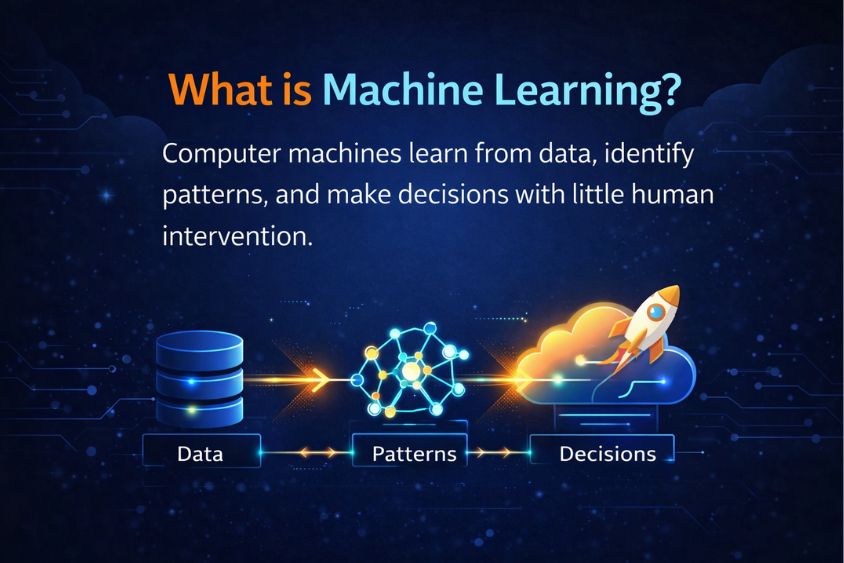
Before jumping directly into the machine learning MLA-C01 machine learning engineer exam section, it is better to understand what is machine learning (ML).
Machine learning empowers computer machines to learn from data, recognize different patterns, and make decisions with little human intervention. Rather than being explicitly coded with rules, algorithms use data to enhance their performance over time, automating tasks such as prediction, recommendation, and categorization.
Machine learning algorithms are proficient of identifying patterns and correlations in data. When given historical data, these algorithms may reduce dimensionality, cluster data points, categorize information, forecast outcomes, and even generate new material. GitHub Copilot, Claude, and ChatGPT from OpenAI are a few examples of the latter, sometimes known as generative AI.
Why is Learning About ML Important?
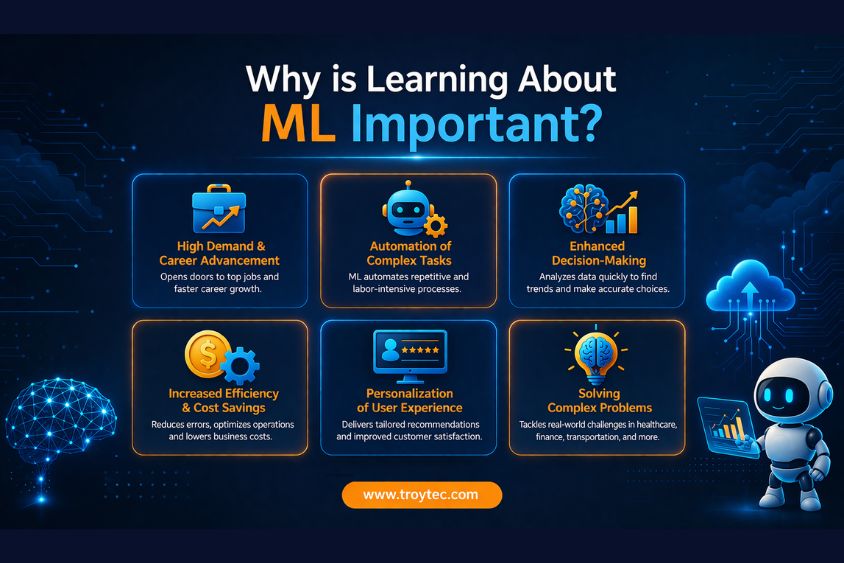
Learning Machine Learning (ML) is critical because it allows computers to analyze large datasets, automate complicated activities, and make accurate predictions, hence driving innovation in many sectors. It is critical for developing smart, scalable solutions such as AI assistants, fraud detection, and tailored recommendations—that increase productivity and competitiveness in a data-driven environment.
Here’s why knowing ML is essential:
- High Demand and Career Advancement: Employers value machine learning engineer abilities for professions such as data scientists, AI specialists, and software engineers, which may lead to greater work possibilities and faster career progression.
- Automation of Complex Tasks: Machine learning (ML) enables systems to learn from data and automate labor-intensive operations like customer support chatbots, data input, and resume screening.
- Enhanced Decision-Making: By rapidly evaluating large volumes of data, machine learning assists firms in identifying trends and patterns, resulting in better-informed and accurate business decisions.
- Increased Efficiency and Cost Savings: Machine learning eliminates human error and optimizes business procedures, saving time and money in industries such as manufacturing (predictive maintenance) and logistics.
- Personalization of User Experience: This allows systems to analyze individual user behavior and provide individualized product suggestions, marketing, and content.
- Solving Complex Problems: Machine learning is useful in many sophisticated sectors, such as disease diagnosis in healthcare, fraud detection in finance, and the development of self-driving cars.
Also Read: The Ultimate 4 Guide to AWS Certified Big Data Certification
What is the MLA-C01 Machine learning engineer Exam?
The AWS MLA-C01 (Machine learning engineer) Certification is designed for those in charge of implementing data science or applied machine learning programs on the AWS Cloud. This specialist certification differs significantly from other AWS exams.
For cloud engineers who use Amazon SageMaker and wish to verify their proficiency in cloud architecture, data engineering, DevOps, and data science in relation to machine learning on AWS, there is an intermediate-level certification called AWS Machine Learning Engineer-Associate. Machine learning developers who wish to learn more about sustaining ML ecosystems on AWS will also find it ideal.
You’ll strengthen your knowledge, spot knowledge gaps, and get useful techniques for answering exam-style MLA C01 questions through thorough explanations and walkthroughs. Exam-style example questions are reviewed throughout the course to help you identify wrong answers and improve your test-taking skills.
What are the Important Topics of the MLA-C01 Exam You Should NOT Ignore?
Here are the AWS-Certified-Machine-Learning Exam domains you need to know:
1. Machine Learning Data Engineering
- Knowing how to use AWS services like S3, Glue, and Redshift for data collection, storage, and management
- Methods for ingesting data, such as batch and real-time streaming (Kinesis)
- Pipelines for data preparation, transformation, and cleaning
- Managing feature scaling, normalization, and missing data
- Optimizing performance and cost by selecting the appropriate storage format
2. Exploratory Data Analysis (EDA)
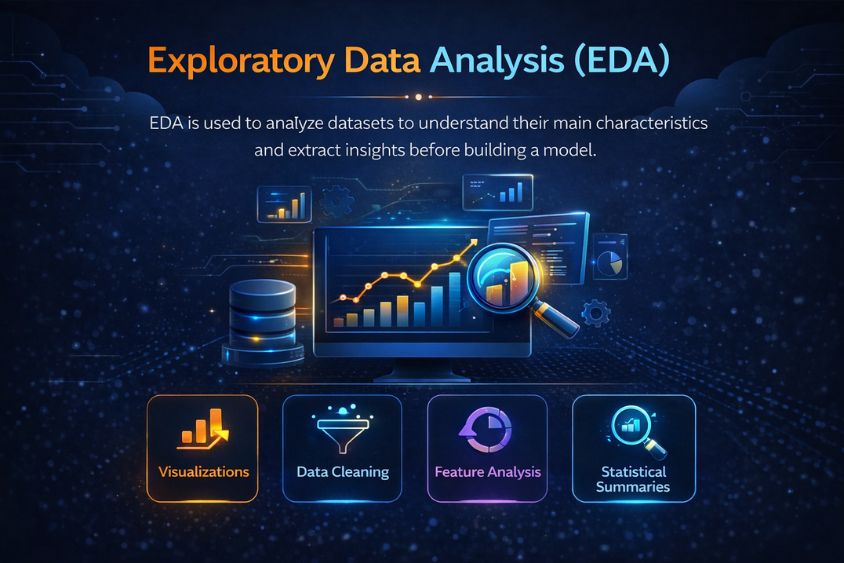
- Finding trends, patterns, and abnormalities in datasets
- Using visual aids to comprehend the relationships and distribution of data
- Identifying anomalies and managing distorted data
- Selection of features and assessment of their significance
- Fundamentals of statistical analysis for making decisions in MLA-C01
3. Modeling and Machine Learning Algorithms.
- Supervised learning (classification and regression models)
- Unsupervised learning (clustering, dimensionality reduction)
- Model selection depends on the dataset type and business problem.
- Overfitting vs. underfitting: how to handle them
- You can use metrics evaluation include accuracy, precision, recall, F1 score, and ROC-AUC.
4. Feature Engineering
- Developing useful characteristics from raw data.
- Encoding categorical variables (one-hot label encoding)
- Feature scaling and transformation approaches
- Dimensionality reduction approaches, such as PCA
- Managing imbalanced datasets
5. Model Training and Optimization.
- Training models using AWS SageMaker
- Hyperparameter tuning approaches
- Cross-validation strategies to improve performance
- Choosing an appropriate training technique for huge datasets
- Cost optimization during training.
6. Inference and Deployment
- Model deployment using AWS SageMaker endpoints
- Real-time versus batch inference
- Scaling machine learning models in real-world settings
- Tracking latency and endpoint performance
- Including machine learning models in applications
7. Security, Upkeep, and Monitoring
- Tracking model performance and identifying drift
- ML pipeline logging and debugging
- IAM roles for data security and access control
- Maintaining Governance and Compliance
- Retraining and updating models over time
8. AWS Machine Learning Services: Essential Information
- SageMaker on Amazon (core service)
- AWS Glue for processing data
- Storage on Amazon S3
- Lambda on AWS for automation
- Amazon Kinesis for data streaming
Also Read: AWS Certified Specialty BDS-C00 Exam: Ultimate Success Guide
Everything You Should Know About Machine learning engineer MLA-C01 Certification
If you have to question, is the investment worth the money? The potential, quick answer is: YES.
· Exam Fees And Training Costs
The MLA-C01 exam fee is USD 300, including all taxes.
The cost of study materials and instruction ranges from $100 to $250, including courses, laboratories, and mocks.
There are also free courses and assessments available on the Internet.
With a Troytec membership, you may access all of these materials, as well as additional courses, for the price of one.
· Prerequisites For The MLA C01 Exam
Of course, with no technical background or data science skills, the certification is appropriate for:
- Cloud Engineers and Developers.
- Data analysts
- AI/ML enthusiasts.
- Professionals switching from DevOps or conventional IT to Machine Learning.
AWS recommends at least 1-2 years of machine learning experience or a deep learning background; many people begin with a basic cloud or data background.
How to Pass the MLA-C01 (Machine learning engineer) Exam in 2026?
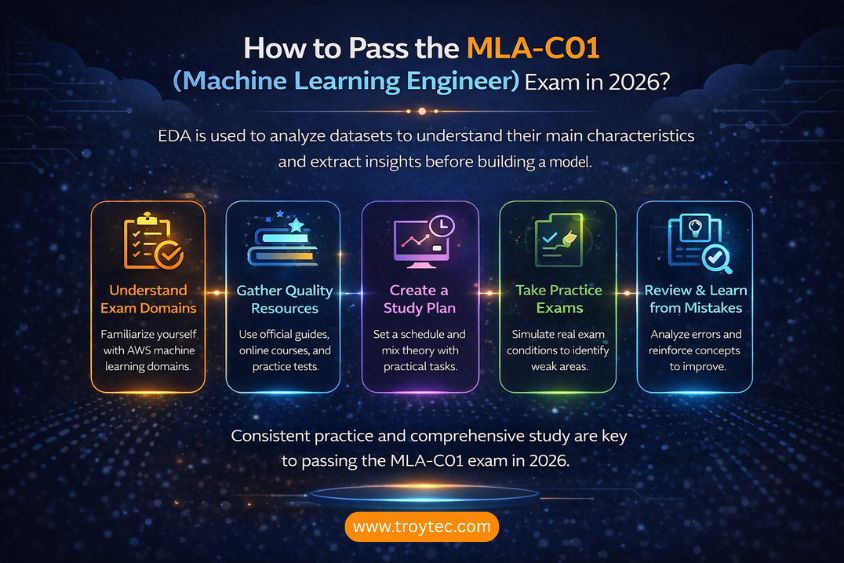
Here is the MLA C01 exam guide that we found useful. Let us begin.
1. Schedule The MLA-C01 Exam.
The most important advice we can offer you is this. Although it may not appear to be a recommendation, we can assure you that studying either with or without an exam in mind makes a significant difference.
Your brain understands that you need to prepare for the approaching AWS Certified Machine Learning Engineer MLA C01 Exam; therefore, you prioritize qualifying training. According to our observations, study quality has also significantly improved. Without a due date, you only finish your schoolwork in your “spare time.” Setting a goal is therefore quite crucial.
2. Understand your machine learning metrics and statistics.
As previously said, the goal of this MLA-C01 (Machine Learning Engineer) exam is to examine your current grasp of machine learning theory. As a result, you must grasp popular probability distributions such as Poisson, Bernoulli, and Normal (Gaussian), as well as when to apply each according to the job.
The most often used ML assessment metrics for classification and regression issues should be recognizable to you. You should be able to compute and explain regression’s MSE, RMSE, and MAE.
3. Recognize Managed AI Services and SageMaker.
The jobs machine learning engineer or MLA C01 Exam covers the following AWS-managed AI services: Translate, Textract, Recognition, Polly, Comprehend, Kendra, Lex, and Personalize. In the best-case scenario, the operation of each of these services and their interoperability should all be clear to you. Whenever feasible, employing managed AI is more effective than creating your own model.
4. Networking, IAM, and Security
The level of the MLA C01 (Machine Learning Engineer) exam is specialized. It is thus anticipated that you will be comfortable with AWS’s “common ground.”
The following topics should be familiar to you: networking fundamentals (VPC, public and private subnets, NAT pathways, route tables, etc.), data security (including encryption choices), and access control using IAM.
Furthermore, a large portion of SageMaker’s data is sourced via S3. You should be familiar with its several tiers, range of costs, and encryption methods.
5. Acknowledge your potential for success.
Even if the MLA C01 test is difficult, passing it is possible with dedication and hard work. If you have been working with AWS for three months, we suggest starting with more basic courses like Cloud Professional or Solutions Architect Associate instead of completing this test.
Be dependable, take your time, use prudence, and concentrate on your studies. Remember that a test like this is conducted “brick by brick.”
Conclusion
Candidates with the MLA-C01 AWS Certified Machine Learning Engineer – Associate certification are given preference by employers as machine learning becomes more prevalent worldwide. IT is having trouble filling the positions of AI/ML engineers at the same time. As a result, there is a growing need for trained professionals, and employers are paying them well.
FAQs (Frequently Asked Questions)
What Is MLA-C01?
A candidate’s ability to develop, operationalize, deploy, and manage machine learning (ML) solutions and pipelines utilizing the AWS Cloud is validated by the AWS Certified Machine Learning Engineer-Associate (MLA C01) exam.
What Is The Passing Score For The MLA-C01 Exam?
Your exam results are shown as a scaled score between 100 and 1,000. A score of 720 is required to pass.
How To Prepare For MLA C01?
Get practical experience with Amazon SageMaker, data engineering (Glue, EMR), and MLOps pipelines to get ready for the AWS Certified Machine Learning Engineer – Associate (MLA-C01) exam.
What Is a Difference Between MLS-C01 or MLA-C01?
The topic, degree of difficulty, and target audience are the main distinctions between MLS-C01 and MLA-C01. MLA C01 is a more recent associate-level certification that focuses on MLOps, whereas MLS-C01 is an older specialized certification that focuses on advanced data science theory and modeling.
What’s The Salary With AWS ML Certification?
As of 2026, an AWS Certified Machine Learning expert in the US may anticipate high pay, often averaging between $140,000 and $170,000+ annually.
