
|
❝
When comparing ABA career pathways, experts consider the BCaBA exam to be a critical qualification for verifying core behavior analysis abilities under BCBA supervision. It emphasizes behavioral evaluation, intervention methodologies, ethics, and client-centered practices, making it suitable for entry-level applied behavior analysis positions. ❞
|
Introduction
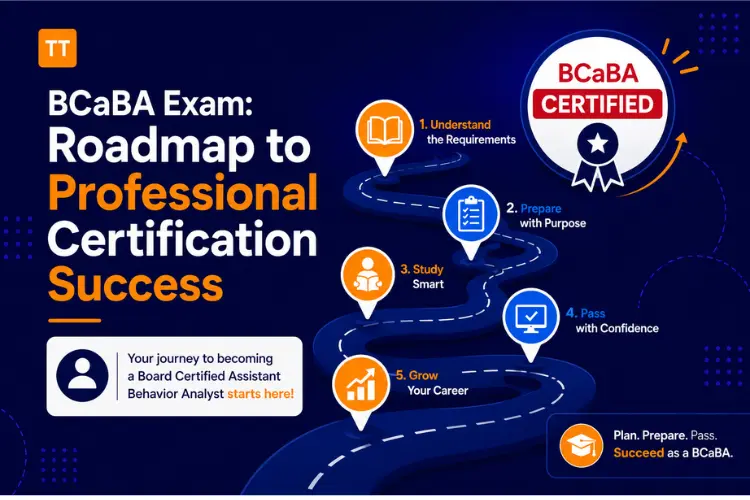
You have to first meet the necessary educational and practical requirements to become a Board Certified Assistant Behavior Analyst (BCaBA). Candidates must first get a bachelor’s degree from an accredited institution, then enroll in behavior analysis courses that meet the Behavior Analyst Certification Board’s requirements. The BCaBA exam requires dedication and concentration to thorough academic preparation that prepares professionals for practical situations.
Beyond academic requirements, prospective BCaBAs require directed fieldwork hours to get practical experience. This practical component guarantees that students can use their academic knowledge successfully. Behavior analysts, like experts who pursue Cisco network security certifications to certify their skills, must demonstrate proficiency through supervised practice.
Keep reading and exploring to learn how to become a board-certified behavior analyst using the most remarkable BCaBA exam questions.
What is a BCaBA Exam?
The BCaBA exam is a meticulous standardized exam offered by the Behavior Analyst Certification Board (BACB) to candidates for the Board Certified Assistant Behavior Analyst® credential.
This level of certification involves an undergraduate degree, behavior analysis coursework, supervised practice, and passing the BACB’s behavior analysis test. Those with BCaBA certification cannot practice autonomously and must be supervised by a BCBA/BCBA-D.
BCaBAs can oversee RBTs and others who use behavior-analytic treatments and their work. BCaBAs can collaborate closely with BCBAs to develop interventions and programs for clients.
The Real Value of a BCaBA Exam
The BCaBA certification is globally recognized, indicating that a person has completed a specified level of training and passed an exam demonstrating proficiency in behavior analysis.
It is a certificate for persons who have a bachelor’s degree in human studies and work or want to work in sectors where research-based learning techniques are used to change socially meaningful behavior.
Because of the alarmingly increasing number of children who are diagnosed with ASDs and the scarcity of trained behavior analysts, job opportunities for certified behavior analysts are plentiful.
Certified behavior analysts are frequently paid more than those around them and health professionals with equivalent levels of training due to the high demand for certified behavioral analysts.
BCaBA Exam Outline
Here is an exam breakdown you must know before you take the BCaBA exam:
| Factor | Information |
|---|---|
| Exam Code | BCaBA |
| Exam Name | Board Certified Assistant Behavior Analyst |
| Exam Official Partner | Pearson VUE |
| No. of Questions | 150 |
| Exam Format | MCQs |
| Exam Mode | Computer-Based |
| Total Duration | 240 minutes (4 hours) |
| Exam Cost | Certification Application: $175 USD
Exam Retake Application: $120 USD Exam Appointment Fee (Paid to Pearson VUE): $125 USD Initial Course Evaluation: $100 USD |
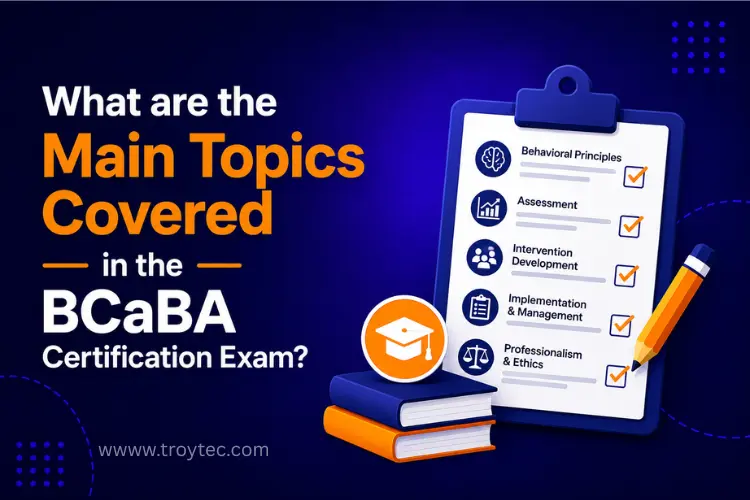
What are the Main Topics Covered in the BCaBA Certification Exam?
Here are the main domains that are included in the BCaBA exam, which you must not neglect in your preparation strategy:
Domain 1: Fundamental Behavior and Analytical Skills
- Measuring
- Experimentation
- Considerations for Behavioral Change
- The Fundamental Elements of Behavior Change
- Unique Behavior Modification Procedures
- Behavior Modification Systems
Domain 2: Client-Centered Responsibilities
- Identifying The Problem
- Measuring Evaluation Intervention
- Leadership, administration, and supervision.
Domain 3: Fundamental Understanding.
- Explain and act in accordance with the philosophical assumptions of behavior analysis.
- Define while providing examples of the following:
- Differentiate the Verbal Operants.
What Can You Do With A BCBA?
Behavior analysts often work with people who have developmental impairments, such as autism.
Behavior analyst experts study the links between behaviors and surroundings and collaborate with their clients to establish or alter new habits.
As a behavior analyst, you may work in a therapeutic setting, a public school, or a business office that specializes in organizational behavior management.
Various sorts of behavior analyst employment are becoming available. For example, the FBI recruits behavior analysts for its behavioral analysis units. Duties may include investigating the psychological implications of terrorist attacks and crimes in which both adults and children are victims.
Other ABA pathways you might follow include:
- Developing skills for patients with brain injuries.
- Behavior Gerontology
- Behavioral Sport Psychology
- Drug Use Disorders
- Behavior Analysis in Ecological Sustainability
Many behavior analyst professions need a BCaBA or BCBA certification, which demonstrates to employers and clients that you have the knowledge and abilities to perform behavior analysis services.
CompTIA Security+ Certification Study Plan, Jobs & Salary Guide
BCBA vs BCaBA: Which One is Better?
- BCBA (Board Certified Behavior Analyst) is an advanced-level qualification for professionals who independently analyze, create, and oversee behavior analysis treatment programs.
- BCaBA (Board Certified Assistant Behavior Analyst) is an entry-to-mid-level credential for professionals who provide behavior analysis solutions under the supervision of a BCBA.
Below is a quick BCBA vs BCaBA exam comparison table for your better understanding of the key differences between the two:
| Factor | BCBA | BCaBA |
|---|---|---|
| Certification Level | Advanced professional certification | Assistant-level certification |
| Education Requirement | Master’s degree required | Bachelor’s degree required |
| Supervision | Able to work independently | BCBA supervision is required |
| Career Role | Behavior analyst and supervisor | Assistant behavior analyst |
| Salary Potential | Higher earning potential | Moderate earning potential |
| Career Growth | Greater leadership opportunities | Pathway toward BCBA certification |
| Best For | Experienced professionals seeking independent practice | Beginners entering the ABA field |
Also Read: PCEP Ultimate Guide: Proven Strategy to Pass on First Attempt
Top 10 Practice BCaBA Exam Questions to Prepare
Here are the top 10 BCaBA mock exam questions you can look at before buying the premium BCaBA exam bundle from Troytec:
Question 1:
Patrick is enrolled in a toilet training program. Moira, his trainer, urged him to use the restroom throughout the first few sessions, and she rewarded him with sweets and praise each time he did it correctly. Moira was eventually able to remove the instructions as Patrick learned to use the toilet and void independently. Which of the following best characterizes the process?
- Establishing operations
- Negative reinforcement
- Switching from responsive to operant behavior
- Transfer of stimulus control.
Question 2:
Fiona is unable to open her lunchbox unaided. It is lunchtime. The instructor closes the latch on Fiona’s lunchbox and sets it in front of her. The teacher altered the
- Consequence
- Setting up operations
- Contingency
- Prompt
Question 3:
A functional link exists when two occurrences
- They have comparable material
- Consistently co-vary
- Happens at the same rate
- Occur simultaneously
Question 4:
Larry participates in self-destructive conduct, which is sustained by automatic reinforcement. This activity causes abrasions on both of his arms as a result of excessive scratching. As a first effort to decrease the tendency, the behavior analyst instructs Larry to wear exclusively long-sleeved shirts. This is an example of what kind of procedure?
- Extinction
- Deprivation
- Punishment
- Differential reinforcement
Question 5:
A person participates in target behaviors in situations other than the initial training environment. This is a demonstration.
- Stimulus generalization
- Response Generalization
- Stimulus discrimination
- Response Induction
Question 6:
NOTE: This is one of the most important BCaBA exam questions.
Terry’s pulse rate rises, and he begins to sweat as he approaches the dentist’s office, which is connected with painful, unpleasant dental procedures. He is also hesitant to schedule appointments and appears to prefer to do anything other than go to the dentist. His bodily symptoms serve as an illustration.
- Operant behavior
- Respondent conduct
- Escape Conditioning
- Aversive Conditioning
Question 7:
The regulation of echoic behavior comes from
- A nonverbal stimulus, a response that fits the stimulus, and a particular reinforcer.
- There is a verbal stimulus, the response fits the stimulus, and the reinforcer is not particular.
- A verbal stimulus, a response that fits the stimulus, and a particular reinforcer.
- verbal stimulus, the reaction does not match the stimulus, and the reinforcer is not particular.
Question 8:
Contingency-shaped behavior includes:
- Based on phylogeny, rule-governed behavior is based on ontogenesis.
- established as a result of the relationships between unconditioned stimuli, response classes, and reinforcement.
- less susceptible to extinction than rule-governed behavior.
- Formed as a result of an individual’s experience.
Question 9:
A descriptive evaluation often contains all of the following, EXCEPT:
- Developing theories
- Collecting both historical and current materials
- Data shown graphically
- The manipulation of variables
Question 10:
Katie now refuses to create stir-fried veggies after her hand brushed the side of the very hot pan as she was learning how to do so. Her reluctance is the outcome of.
- Negative penalty
- Negative reinforcement
- Conditioned punishment
- unconditional punishment
Prepare smarter with realistic BCaBA practice questions, exam-focused material, and study resources.
Explore Troytec BCaBA Practice Exam →
How To Become A Board Certified Behavior Analyst?
The BCaBA describes two paths that can lead to BCaBA accreditation. Both courses require a bachelor’s degree and passing the BCaBA exam.
-
BCaBA Pathway 1
The first track requires a bachelor’s degree or higher from an ABAI-accredited school. The program must have been accredited at the time you completed your degree.
You must also have finished 1,300 hours of fieldwork supervision, or 1,000 hours of intensive supervised fieldwork. Formal supervision is required for 5% of regular supervised fieldwork hours and 10% of focused supervised fieldwork hours.
Your supervisor must also meet specific standards to be eligible.
-
BCaBA Pathway 2
The second option also needs a bachelor’s degree or higher and supervised fieldwork, but the degree does not have to be from an ABAI-accredited institution. This is replaced with behavior-analytic coursework, which must include these curriculum areas:
- BACB’s Ethics Code and Code Enforcement System: Professionalism
- Philosophical foundations: concepts and principles
- Measurement, information display, and interpretation; experimental design
- Behavior Analysis
- Behavior Change Procedures: Choosing and Implementing Interventions
- Labor Supervision and Management
Both BCaBA exam paths require passing the certification test.
Conclusion
Because the BCaBA Exam is a certification available to persons in a variety of fields, finding a precise salary may be challenging. A support behavioral analyst may expect to earn around $45,000 per year. These data are for analysts who operate mostly in the education and science domains. In general, a board-certified associate behavior analyst earns significantly more than their uncertified counterparts in the same job.
Other careers pay more, but need more education and experience. For example, psychiatrists and sociologists, both of whom hold BCaBA Exam credentials, make around $80,000 per year. With BCBA practice exam free you can prepare well for the BCaBA test. BCBA practice test is the best approach to reach to BCaBA level.
FAQs (Frequently Asked Questions)
There is a total of 150 questions in the BCaBA exam, which you must answer within 4 hours.
Q2: What Level Of Education Do I Need To Be A BCaBA?
A college-level degree from an authorized university, as well as particular courses in behavior analysis. While a degree in psychology is appropriate, any study on human behavior will aid incorporation into therapeutic teams.
Q3: How Long Will It Take To Become BCaBA Certified?
It depends. It might take as little as 12 months, particularly for people with prior job experience as an ABA practitioner.
