
|
❝
Advanced SOA security solutions include Zero Trust Architecture, API protection, encryption, authentication standards, and continuous monitoring to safeguard distributed corporate services, APIs, and communication layers from cyber-attacks. Modern security SOA architecture uses OAuth 2.0, SAML, mTLS, WS-Security, limiting privileges access, and AI-driven threat detection to protect linked business systems in cloud, hybrid, and on-premise settings. ❞
|
Introduction
Organizations must have strong security measures in place to protect themselves against cyber-attacks. A cyber-breach might result in high costs for your firm. So, what can we do to assist in preventing such breaches? This is the goal of a robust SOA security architecture to decrease cybersecurity dangers and the costs that may come from them.
You constructed the architecture. You launched the services. You thought you’d finished. But here’s the sad fact that most architects don’t see until it’s too late: an unsecured security SOA is more than just a technical debt because it’s an open door that someone has already walked through.
Keep reading and exploring to learn what Service-Oriented Architecture (SOA) is, best practices, and common challenges a business can face.
What is Service-Oriented Architecture (SOA)?
SOA is a modular design framework that allows services to connect across a network.
In simple terms, Service-Oriented Architecture (SOA) is a method of creating software that divides the system into distinct, independent components. Each component does a specialized task, like keeping information or handling sign ins, and it kind of runs on its own. These parts, usually called services, talk to each other through the internet, using typical data structures like JSON or XML, so they can coordinate without too much concern.
Think of SOA technology concept as a network of independent but interacting components instead of a single, centralized system. Every service stands out in one area, much like a member of a specialist team, and together they offer the greater capability required by an application.
For example:
- A customer care app can contact a payment processing provider without understanding how it is coded.
- An inventory system can automatically update order data via common APIs.
This decoupling not only increases flexibility but also improves security and scalability, which is why security SOA remains a cornerstone of business design and cybersecurity frameworks.
What is a SOA Security Architecture?
SOA security refers to the policies, standards, and methods that safeguard services, their communication routes, and the data that flows across the ecosystem.
Unlike traditional application security, which frequently focuses on a single boundary, advanced SOA security must work across an autonomous mesh of interdependent services, each of which may be both an entrance point and a blast radius.
Security SOA consists of three layers: the transport layer (which secures the communication channel), the message layer (which secures the content), and the service layer (which controls who may call what and when). If any of these are neglected, the entire architecture becomes weak.
Common SOA Security Risks Every Business Should Know
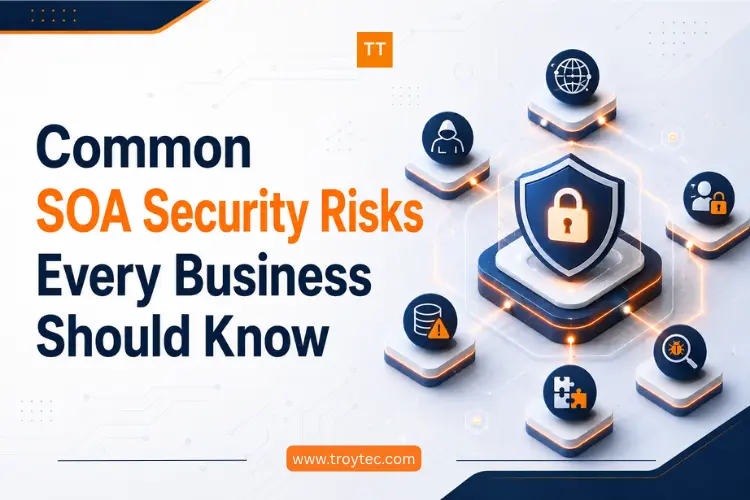
Here are the most fundamental SOA security architecture challenges or risks a business must be aware of before implementing the advanced security architecture:
1. Legacy Application Security
SOA services that encapsulate legacy applications must consider the heritage application’s security model. Many older programs use hardcoded, proprietary security models.
2. The Loose Connection Of Services And Applications
SOA-security must not break SOA architecture concepts, such as loose connections between services and applications.
3. Services That Span Organizational Boundaries
In the past, many enterprises relied significantly on network security to protect applications. However, SOA services frequently traverse corporate boundaries. It is not sufficient to safeguard the perimeter using network devices such as firewalls.
4. Dynamic Trust Relationships
SOA services are frequently required to facilitate dynamic trust relationships among partners, consumers, and workers.
5. Insecure Message Transmission
Unencrypted inter-service messages make critical corporate data vulnerable to spying and man-in-the-middle (MitM) attacks within an organizational network.
6. Composite Services
The security model must support scenarios in which many services collaborate as a composite service.
7. A Mix of Legacy and Modern Technologies
Need to handle security and identity across several systems and services.
8. ESB: Single Point of Failure
When the Enterprise Service Bus is hacked, it becomes a master key, allowing an attacker to control any service that it routes.
9. Need To Comply With An Increasing Range Of Criteria.
SOA is standards-oriented. There is an increasing list of SOA-related security standards. SOA security solutions are expected to be based on established standards.
Authentication & Authorization in SOA
Identity in a Service-Oriented Architecture (SOA) context is not a binary notion. A request does not simply originate from “a user”; instead, it comes from a user working through a client application reaching a frontend service, which in turn reaches a backend service that searches a data layer. Each link in this chain calls for an independent trust decision.
Identity Standards for SOA
The fundamental identification mechanisms for SOA architecture are well-established:
- SAML 2.0 remains the corporate standard for federated identification in older SOA settings, especially in healthcare and government. Offers XML-based assertion of identity, responsibilities, and characteristics across trust domains.
- OAuth 2.0 + OpenID Connect is the contemporary authorization mechanism for REST-based SOA applications. Allows token-based delegation without revealing credentials across services.
- WS-Security is an OASIS standard for implementing security directly to SOAP communications. Supports login information tokens, X.509 certificates, and Kerberos tokens at the message level rather than merely the transport level.
- Mutual TLS (mTLS) entails both the client and the server presenting certificates, providing two-way authentication for all inter-service communications. Critical in high-assurance SOA setups.
Authorization: Beyond Role-Based Access
RBAC alone is insufficient for security SOA. Modern SOA security design necessitates Attribute-Based Access Control (ABAC) – authorization choices that include the user’s context (device, location, time, risk score) as well as their function. This is where SOA connects with the NIST SP 800-162 recommendations for enterprise ABAC adoption.
SOA vs Microservices Security: What’s the Difference?
SOA vs microservices security is not always an either-or decision. Many organizations use both models: SOA for enterprise integrations and microservices for cloud-native applications. In practice, most businesses do not choose between the two; instead, they run both at the same time, with microservices handling new workloads and SOA security powering crucial old connections. Understanding the security distinctions between the two is critical for any SOA- security professional. Here’s a short overview of both services.
- SOA-Security: Service-Oriented Architecture (SOA) Security focuses on protecting centralized corporate services, communication protocols, and common infrastructure.
- Microservices Security: This approach combines decentralized and API-driven security mechanisms to safeguard individual, loosely linked services.
Here is a quick SOA vs microservices security comparison table so that you can understand the basic difference between the two:
| Factor | SOA Security | Microservices Security |
|---|---|---|
| Architecture Style | Centralized service architecture | Distributed independent services |
| Security Approach | Centralized governance and policies | Decentralized service-level security |
| Communication | ESB-based communication | API and lightweight protocol-based communication |
| Authentication | Central identity and access control | Token-based authentication, such as OAuth and JWT |
| Scalability | Limited scalability | Highly scalable security model |
| Attack Surface | Smaller but centralized risk | Larger distributed attack surface |
| Monitoring | Centralized tools for monitoring | Distributed observability and traceability |
| Deployment Security | Enterprise-focused environments | Cloud-native and container security |
| Best For | Traditional enterprise systems | Modern cloud and DevOps environments |
| Complexity | Easier centralized management | More complex due to many services |
Verdict: SOA is best-suited for organizations that need to link several systems, whereas microservices are best suited to contemporary, dynamic applications.
Read Also: SY0-701: High Impact Preparation Strategy for Serious Candidates
What is Zero Trust for SOA Environments?
Zero Trust is not a thing you purchase. It is a philosophy that you implement. And, for SOA settings, which have traditionally been built on implicit internal Trust, Zero Trust is both the most critical and disruptive security reform.
Traditional perimeter-based security precautions are no longer enough for dispersed business systems.
This is why enterprises are increasingly implementing Zero Trust Architecture (ZTA) for SOA security.
Never trust, Always verify
All service requests, regardless of network location, must be authenticated, approved, and verified.
Zero Trust Security Controls
Continuous Identity Verification: User and service authentication is ongoing.
- Least Privilege Access: Services only receive the necessary permissions.
- Micro-segmentation: Network segments help to decrease lateral movement risk.
- Real-time monitoring: It detects suspicious behavior as soon as it occurs.
- Device Trust Validation: Endpoint administration must fulfill security requirements before accessing services.
Zero Trust greatly decreases insider risks and lateral attack mobility in SOA systems.
Why Do Organizations Continue To Choose SOA?
SOA offers major operational and strategic benefits.
- Accelerated Development: Teams may utilize existing services across many projects, decreasing time to release.
- Scalability: Each service may be added or removed as needed, without impacting the rest of the system.
- Interoperability: Legacy systems and new applications can coexist by encapsulating older capabilities as services.
- Cost Efficiency: Minimizing duplicate development results in long-term savings.
- Adaptability: Modifications in business logic or customer requirements may be handled more freely.
Top SOA Security Best Practices Every Business Should Know
Here are the top SOA security best practices every business must know:
Secure Your Messages, Not Only Your Channels
Apply XML Signature to essential payloads to ensure their integrity from beginning to end, and apply XML Encryption for truly sensitive data to safeguard the payload regardless of what it travels through.
Integrate Identification Into Each Service Call
Services are not anonymous participants; they are principals with identities, and each call they make should include a valid credential.
Replace IP-based security and network location constraints with explicit service identities supported by certificates or token federation. When every caller is known and validated, unlawful lateral movement becomes far more difficult to carry out covertly.
Apply The Least Privilege Diligently And Constantly
In business contexts, the natural tendency is to provide too many permissions. A service has access to a resource once, and it has never been evaluated or withdrawn.
Audit service account permissions on a regular basis, not only upon deployment.
If a service has not utilized a permission in the last quarter, consider whether it still requires it. Over-permissioned services are not a theoretical issue; they cause breaches to become catastrophic rather than confined.
Validate All Inputs At Each Border
Disable XML external entity processing in all parsers. Limit the size of payloads. Most injection attacks succeed not because protections have failed, but because validation was never established in the first place.
Protect Your WSDL And Service Discovery Endpoints
Restrict WSDL access to authenticated users, and never expose finding services endpoints to public networks without proper access restrictions.
Make Logs Non-Negotiable And Systematic
In a SOA security context where hundreds of services exchange thousands of messages per second, unstructured or inconsistent logging is equivalent to no logging.
Every service request, authentication event, authorization decision, and aberrant response should be documented in a structured manner, timestamped, connected with a trace ID, and sent to a centralized log management system.
When an event happens, you will be unable to reconstruct what happened within a distributed service topology unless this foundation is in place.
Test SOA Security Explicitly, Rather Than Broadly
A normal web application penetration test will not identify the most critical vulnerabilities in an SOA system. You require testers who comprehend SOAP injection, WSDL sampling, ESB routing manipulation, XML-based attacks, and service chaining exploitation.
Schedule SOA-specific security evaluations at least once a year, and use focused threat modeling anytime new services are introduced or old services are significantly altered.
Treat Security As A Service Lifecycle Concern, Rather Than A Deployment Checkbox
Integrate static evaluation and dependency scanning into your build workflow to detect vulnerabilities before they reach production.
Security debt accumulates in the same way that technical debt does, and in SOA settings, it accumulates across all services that inherit a problematic dependence.
Role of a SOA Security Specialist
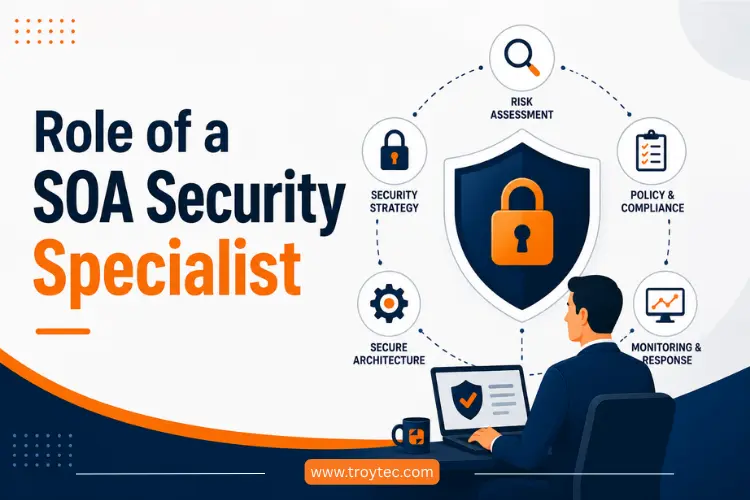
An SOA Security Specialist is in charge of defending distributed corporate systems, APIs, and service communication layers against cyber-attacks.
As organizations increasingly rely on Service-Oriented Architecture (SOA), these specialists play an important role in protecting sensitive data, applications, and linked services in both cloud and on-premise environments.
Their function extends beyond standard network security since SOA setups comprise several services that communicate continually via APIs, SOAP, XML, and corporate middleware.
Key Responsibilities
- Develop a robust Service-Oriented Architecture (SOA) security architecture for corporate applications.
- Implement authentication mechanisms, such as OAuth, SAML, and MFA.
- Secure APIs, SOAP Services, and XML Communication
- Monitor company traffic for suspicious behavior and threats.
- Conduct vulnerability evaluations and penetration tests.
- Enforce encryption, access controls, and compliance procedures.
Industries In Need of SOA Security Specialists
- Banking and Fintech
- Healthcare and Insurance
- Government infrastructure
- Telecommunications
- eCommerce platforms
Important Skills
A good Service-Oriented Architecture (SOA) Security Specialist often possesses knowledge in:
- API Security
- Cloud Security
- Identity and Access Management
- DevSecOps
- Zero Trust Security
- Threat monitoring and compliance.
As organizations continue to implement cloud-native and API-driven architectures, Service-Oriented Architecture (SOA) security specialists remain in high demand in modern cybersecurity teams.
Read Also: Can You Get a security Job With Only CompTIA in 2026
Future of SOA Security
Service-Oriented Architecture (SOA) security is continuously developing as businesses embrace cloud-native and AI-powered infrastructures.
Emerging SOA Security Trends
- AI-Powered Threat Detection: Machine learning detects aberrant service activity automatically.
- Behavior-Based Authentication: User behavior patterns enhance access control.
- Cloud-Native SOA Security: Hybrid cloud protection is becoming necessary.
- Automated Compliance Monitoring: Security policies are continually enforced.
- API-Centric Security Models: Modern businesses prioritize API security over traditional perimeter defenses.
The future of Service-Oriented Architecture (SOA) security will rely primarily on automation, AI-powered monitoring, and Zero Trust enforcement.
Conclusion
Now, modern organizations cannot afford to have insufficient service-layer protection. As corporations implement distributed architectures, APIs, hybrid cloud systems, and networked corporate applications, the need for SOA security will only increase.
A well-designed Service-Oriented Architecture (SOA) security system lowers the cybersecurity attack risks, protects vital corporate operations, advances compliance, and builds Trust throughout organizational networks.
Organizations that use strong authentication, API gateway protection, Zero Trust principles, encryption, and proactive monitoring are much better prepared to defend current service-oriented settings against newly developing attacks.
