
|
❝
Azure DevOps Solutions are Microsoft’s end-to-end set of tools that help development and operations teams plan, build, test, and deliver software faster — and they form the entire foundation of the AZ-400 certification exam. ❞
|
Key Takeaways:
- Azure DevOps Solutions is Microsoft’s end-to-end platform for planning, building, testing, and delivering software continuously.
- The platform consists of 5 core services: Azure Boards, Repos, Pipelines, Test Plans, and Artifacts — each covering a different phase of the delivery lifecycle.
- Azure Pipelines is the most critical service for the AZ-400 exam, covering 40–55% of all exam questions.
- Azure DevOps Solutions support any language and any cloud — not just Microsoft technologies or Azure infrastructure.
- Microsoft offers a free tier with 5 users, unlimited private repositories, and 1,800 pipeline minutes per month — enough to build real hands-on experience.
- Azure DevOps and GitHub are complementary — Azure Pipelines can connect directly to GitHub repositories, and the AZ-400 exam tests both platforms.
- Mastering Azure DevOps Solutions is the mandatory foundation for anyone pursuing the Microsoft Certified: DevOps Engineer Expert certification through the AZ-400 exam.
What Are Azure DevOps Solutions?
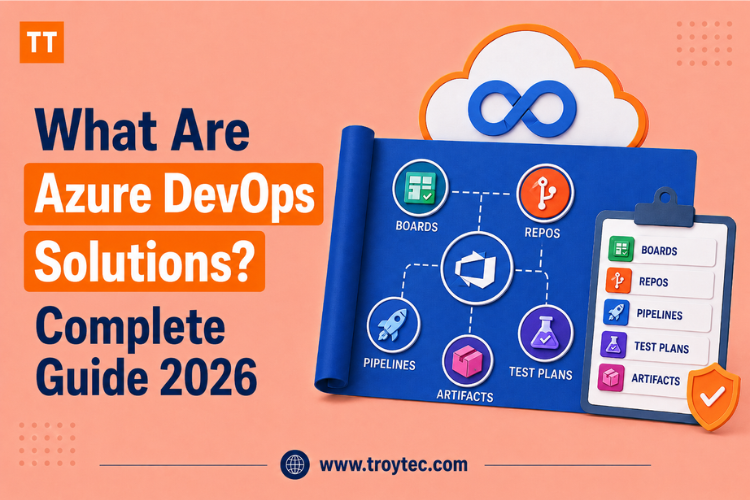
Azure DevOps Solutions are a set of integrated, cloud-based tools provided by Microsoft that support the entire software development lifecycle (SDLC) — from planning and coding to testing, deployment, and monitoring.
Formerly known as Visual Studio Team Services (VSTS), Microsoft rebranded the platform as Azure DevOps in 2018. Since then, it has become one of the most widely adopted DevOps platforms in enterprise environments worldwide.
At its core, Azure DevOps Solutions are built around one principle: breaking the wall between development teams and operations teams so that software is delivered continuously, reliably, and at scale.
Why Azure DevOps Solutions Matter in 2026
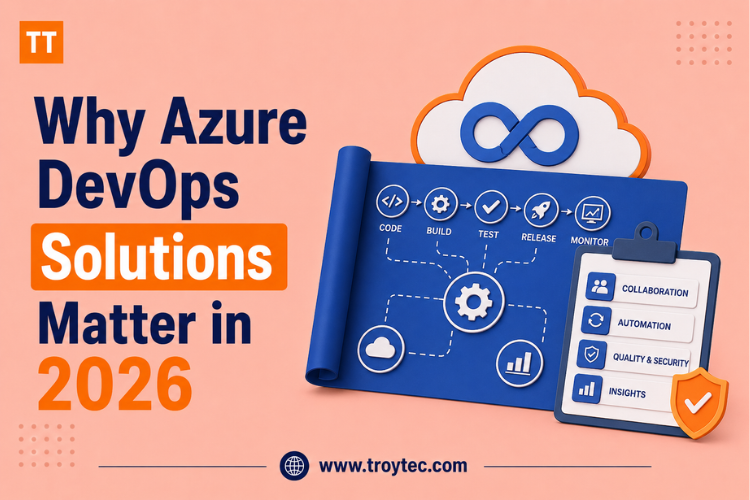
The demand for DevOps engineers has grown by over 40% in the last three years. Organizations are no longer asking whether to adopt DevOps — they are asking how fast they can implement it. Azure DevOps Solutions provide the answer by giving teams:
- A single platform for the entire development workflow
- Native integration with Microsoft Azure cloud services
- Support for both agile and waterfall project methodologies
- Built-in security and compliance controls
- Automation across build, test, and release pipelines
Understanding Azure DevOps Solutions is not just valuable for developers. It is the prerequisite knowledge for anyone pursuing the Microsoft Certified: DevOps Engineer Expert certification through the AZ-400 exam.
The 5 Core Azure DevOps Services Explained
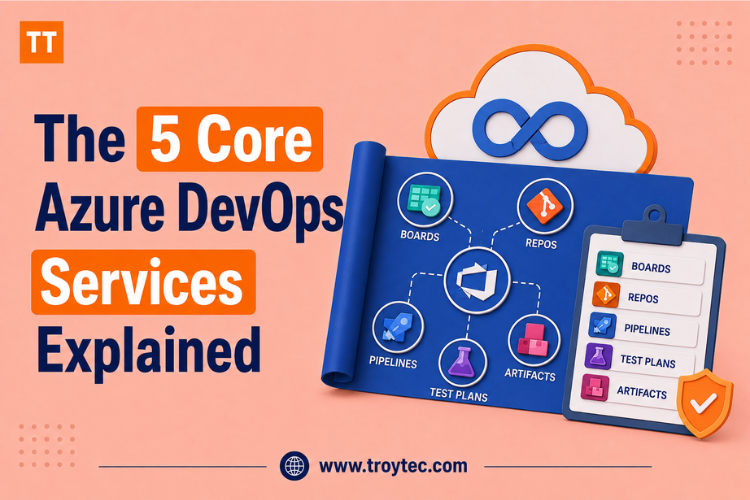
Azure DevOps Solutions are made up of five distinct services. Each one handles a specific phase of the software delivery process. You can use all five together or adopt them individually depending on your team’s needs.
1. Azure Boards
What it does: Azure Boards is the project planning and work tracking service within Azure DevOps Solutions. It gives teams a visual, interactive way to manage tasks, bugs, user stories, and epics.
Key features:
- Kanban boards and Scrum sprint boards
- Work item tracking with custom fields and states
- Backlogs, queries, and delivery plans
- Integration with GitHub for linking commits to work items
- Reporting dashboards with velocity charts and burndown graphs
Who uses it: Project managers, scrum masters, product owners, and development leads use Azure Boards to keep work organized and transparent across teams.
Why it matters for AZ-400: The AZ-400 exam tests your ability to design and implement collaboration strategies. Azure Boards is the primary tool for this domain, and exam questions often involve configuring work item processes, selecting the right process template (Basic, Agile, Scrum, or CMMI), and setting up dashboards.
2. Azure Repos
What it does: Azure Repos provides cloud-hosted version control for your source code. It supports two version control systems: Git (distributed) and Team Foundation Version Control — TFVC (centralized).
Key features:
- Unlimited free private Git repositories
- Branch policies to enforce code review and build validation
- Pull request workflows with inline commenting
- Semantic code search across repositories
- Integration with Visual Studio, VS Code, and third-party IDEs
Who uses it: Software developers and DevOps engineers use Azure Repos to manage source code, collaborate through pull requests, and enforce branching strategies like GitFlow or trunk-based development.
Why it matters for AZ-400: Source control strategy accounts for 10–15% of the AZ-400 exam. You need to understand branching models, repository permissions, branch policies, and how to integrate Azure Repos with CI/CD pipelines.
3. Azure Pipelines
What it does: Azure Pipelines is the continuous integration and continuous delivery (CI/CD) engine of Azure DevOps Solutions. It automatically builds, tests, and deploys code every time a change is pushed to the repository.
Key features:
- Support for any language: Python, .NET, Java, Node.js, Go, Ruby, and more
- Runs on Windows, Linux, and macOS agents
- YAML-based pipeline configuration for version-controlled pipelines
- Integration with Docker, Kubernetes, and Azure App Service
- Approval gates, environments, and deployment strategies (blue-green, canary, rolling)
- Free tier: 1,800 minutes/month for public projects
Who uses it: DevOps engineers, release managers, and platform engineers use Azure Pipelines to automate the path from code commit to production deployment.
Why it matters for AZ-400: Azure Pipelines is the heaviest domain in the AZ-400 exam, accounting for 40–55% of all questions. You must be able to design multi-stage YAML pipelines, configure agents and agent pools, implement deployment strategies, and integrate security scanning into pipelines.
4. Azure Test Plans
What it does: Azure Test Plans provides manual and exploratory testing tools that help QA teams track test cases, manage test suites, and report defects directly within the Azure DevOps Solutions platform.
Key features:
- Manual test case management with step-by-step instructions
- Exploratory testing via the Test & Feedback browser extension
- Test suite organization: static, requirement-based, and query-based
- Rich defect capture with screenshots, screen recordings, and system info
- Integration with Azure Pipelines for automated test results
Who uses it: QA engineers, testers, and developers use Azure Test Plans to ensure software quality before releases reach production.
Why it matters for AZ-400: Test planning and feedback strategies are part of the continuous testing domain. Exam scenarios often ask candidates to recommend the right testing tool for a given situation — Azure Test Plans vs Application Insights vs third-party tools.
5. Azure Artifacts
What it does: Azure Artifacts is the package management service in Azure DevOps Solutions. It allows teams to create, host, and share packages — such as NuGet, npm, Maven, Python, and Universal Packages — internally and with external consumers.
Key features:
- Universal package hosting across multiple feed types
- Upstream sources to proxy and cache public packages (npm, PyPI, Maven Central)
- Fine-grained permissions per feed and package version
- Integration with Azure Pipelines for automated package publishing
- Package lifecycle management with retention policies
Who uses it: Backend developers, DevOps engineers, and build engineers use Azure Artifacts to manage dependencies and prevent reliance on public package registries directly in production pipelines.
Why it matters for AZ-400: Dependency management is a tested domain in the AZ-400 exam. You need to understand how to configure feeds, set upstream sources, and integrate Artifacts into CI/CD pipelines securely.
AZ 400 Practice Test 2026: Free Questions, Dumps & Study Guide
How Azure DevOps Solutions Work Together
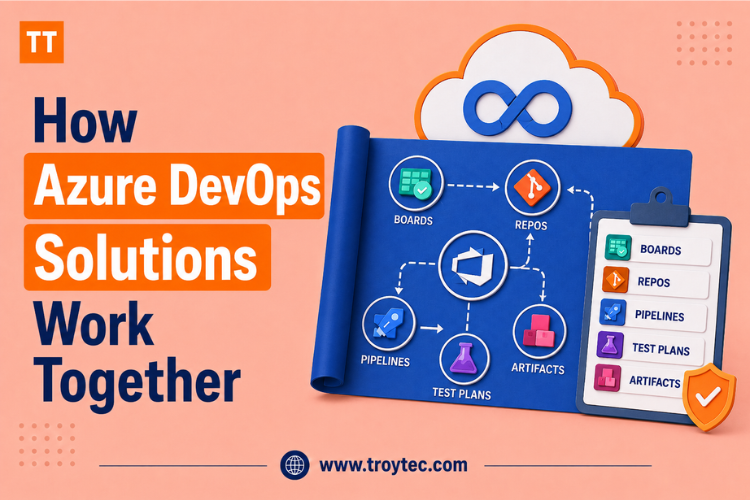
The real power of Azure DevOps Solutions is not in any single service — it is in how all five services connect into one continuous workflow.
Here is what a complete Azure DevOps delivery cycle looks like in practice:
- A product owner creates a user story in Azure Boards
- A developer picks up the task, writes code, and pushes to Azure Repos
- The push triggers a CI build in Azure Pipelines, which pulls dependencies from Azure Artifacts
- Automated tests run inside the pipeline; manual tests are tracked in Azure Test Plans
- If all checks pass, the pipeline automatically deploys to a staging environment
- After approval, the pipeline promotes the release to production
This end-to-end automation is what organizations mean when they say they have implemented a DevOps culture using Azure DevOps Solutions.
Azure DevOps vs GitHub: Which One Should You Use?
Microsoft owns both Azure DevOps and GitHub, which creates a common question: which platform should your team use?
The answer depends on your context.
| Factor | Azure DevOps Solutions | GitHub |
|---|---|---|
| Best for | Enterprise teams, Microsoft stack | Open source, modern startups |
| Project management | Azure Boards advanced | GitHub Projects basic |
| CI/CD | Azure Pipelines highly configurable | GitHub Actions simpler |
| Package management | Azure Artifacts | GitHub Packages |
| Version control | Azure Repos Git + TFVC | Git only |
| Security & compliance | Advanced enterprise controls | Growing enterprise features |
| Integration | Deep Azure cloud integration | Broad third-party integrations |
The practical answer in 2026: Most large enterprises use Azure DevOps Solutions for their structured workflows, compliance requirements, and deep Azure integration. Smaller teams and open source projects lean toward GitHub. Microsoft’s own guidance is that both platforms are complementary — and Azure Pipelines can actually connect to GitHub repositories, giving you the best of both worlds.
For the AZ-400 exam, you need to be familiar with both. Microsoft has been progressively including GitHub Actions and GitHub Advanced Security scenarios in the exam.
Who Uses Azure DevOps Solutions?
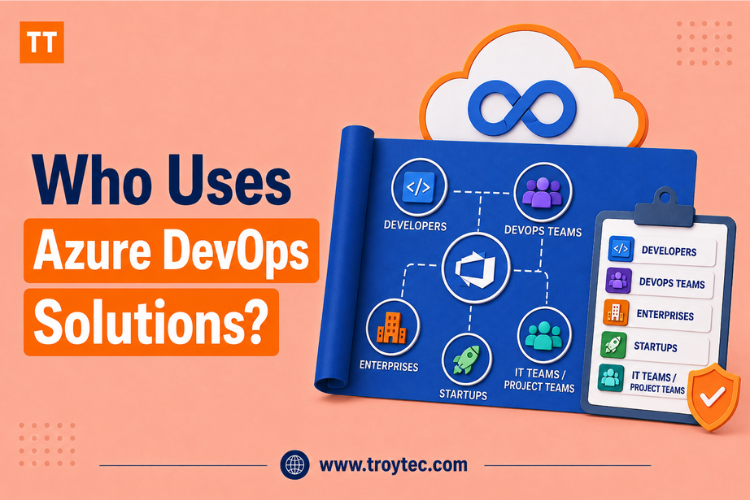
Azure DevOps Solutions are designed for cross-functional software teams. Different roles use different services, but everyone benefits from the shared visibility the platform provides.
Software Developers use Azure Repos for version control and Azure Pipelines for automated builds — eliminating the manual steps between writing code and seeing it deployed.
DevOps Engineers configure and maintain the pipelines, environments, and infrastructure-as-code workflows that keep the delivery process running. The AZ-400 certification validates this role specifically.
QA Engineers use Azure Test Plans to track test coverage and Azure Pipelines to view automated test results in a central location.
Project Managers and Scrum Masters use Azure Boards to maintain backlogs, run sprints, and report on team velocity and delivery progress.
Security and Compliance Teams use Azure DevOps Solutions’ built-in approval gates, branch policies, and audit logs to enforce governance without blocking delivery speed.
Azure DevOps Solutions and the AZ-400 Exam
If you are studying for the AZ-400 exam, understanding Azure DevOps Solutions at a conceptual and practical level is non-negotiable — because the entire exam is built around them.
The AZ-400 exam (Microsoft Certified: DevOps Engineer Expert) tests five domains:
| Domain | Weight | Primary Azure DevOps Service |
|---|---|---|
| Design & Implement Processes & Communications | 10–15% | Azure Boards |
| Source Control Strategy | 10–15% | Azure Repos |
| Build & Release Pipelines | 40–55% | Azure Pipelines + Artifacts |
| Security & Compliance Plan | 10–15% | Azure Pipelines: gates, policies |
| Instrumentation Strategy | 10–15% | Azure Monitor + Application Insights |
Prerequisites: Before sitting the AZ-400 exam, Microsoft requires you to hold either the AZ-104 (Azure Administrator Associate) or AZ-204 (Azure Developer Associate) certification.
Ready to test your knowledge? Once you understand these services deeply, the next step is hands-on exam practice. Visit our AZ-400 practice test guide for full-length simulation questions, a 4-week study plan, and an honest comparison of practice tests vs dumps.
How to Get Started with Azure DevOps Solutions
Getting started with Azure DevOps Solutions is straightforward. Microsoft offers a free tier that is generous enough for most small teams and individual learners.
Step 1: Go to dev.azure.com and sign in with a Microsoft account
Step 2: Create an organization and your first project
Step 3: Choose your process template — Basic for simple task tracking, Agile or Scrum for iterative teams, CMMI for formal change management
Step 4: Connect your code repository — either create a new Azure Repo or connect an existing GitHub repository
Step 5: Create your first pipeline using the YAML editor or the classic visual designer
Free tier includes:
- 5 free users with Basic access
- Unlimited private Git repositories
- 1,800 CI/CD minutes per month
- Azure Artifacts with 2 GB storage
For AZ-400 exam candidates, spending at least 2–3 weeks building real pipelines in a free Azure DevOps organization is more valuable than any amount of reading alone.
Conclusion
Azure DevOps Solutions give organizations a complete, integrated platform to plan, build, test, and ship software continuously. The five core services — Azure Boards, Repos, Pipelines, Test Plans, and Artifacts — cover every stage of the modern software delivery lifecycle.
For professionals pursuing the AZ-400 certification, this is not background knowledge — it is the core subject matter of the entire exam. Understanding how these services connect, how to configure them, and how to apply them in real-world scenarios is what separates candidates who pass on the first attempt from those who struggle.
Start with the concepts in this guide. Then move to hands-on practice in a free Azure DevOps organization. And when you are ready to test your exam readiness, use structured AZ-400 practice tests that mirror the real exam environment.
